How to Train Safely With Hypermobility Without Avoiding Exercise Altogether
Quick Answer: Training safely with hypermobility centers on prioritizing controlled range of motion over maximum range, building surrounding muscle strength to compensate for joint laxity, and avoiding locking out joints at end-range under load — done this way, strength training is generally beneficial for hypermobile joints, not something to avoid.
The instinct for a lot of hypermobile people is to avoid strength training out of caution. The more useful approach is usually training differently, not training less.

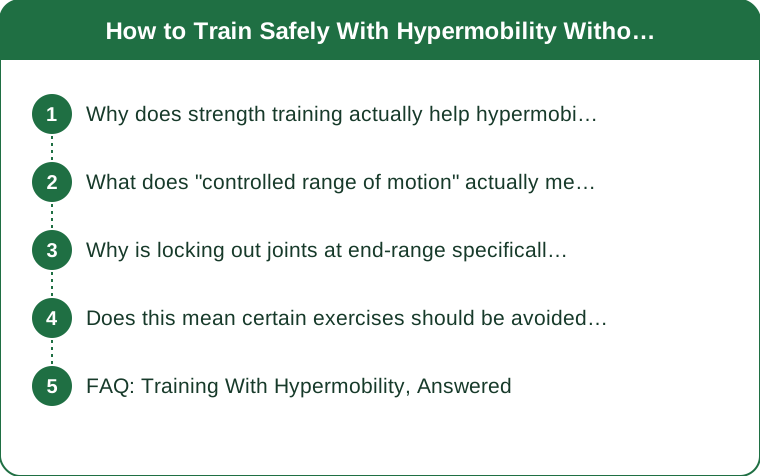
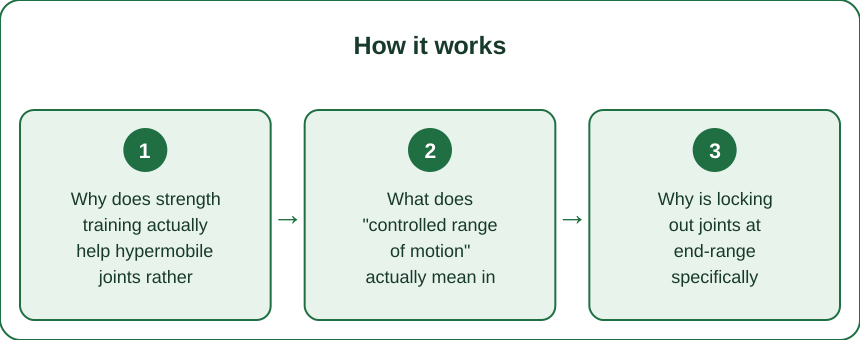
Why does strength training actually help hypermobile joints rather than risk them?
Hypermobility means ligaments provide less natural joint stability than average, which places more of the stabilizing burden on surrounding muscles. Building strength in those muscles directly compensates for the reduced ligament support, meaning appropriately approached strength training tends to reduce, not increase, joint instability and pain over time.
What does “controlled range of motion” actually mean in practice?
Rather than moving through the full available range a hypermobile joint can reach, training within a slightly reduced range — stopping just short of maximum joint extension or flexion — keeps tension on the muscle rather than letting the joint’s ligaments take the load at the extreme end of motion.

Why is locking out joints at end-range specifically discouraged?
Locking out (like fully straightening the knee or elbow under load) shifts load from muscle onto the joint’s passive structures — ligaments and joint capsule — which are already less supportive in a hypermobile joint. A slight, deliberate bend maintained at the joint keeps muscles engaged and bearing the load instead.
Does this mean certain exercises should be avoided entirely?
Generally not entirely avoided, but modified — deep, unsupported end-range stretches and exercises that specifically push a joint to its maximum available range under load are the ones most worth adjusting, rather than eliminating strength training as a category.
FAQ: Training With Hypermobility, Answered
Is stretching safe for hypermobile people?
Generally yes in moderation, though excessive stretching that pushes already-loose joints further isn’t typically beneficial and can increase discomfort.
Should hypermobile people avoid heavy weights entirely?
Not necessarily — appropriately progressed heavy strength training, with attention to form and range of motion, is generally supportive rather than risky.
When should hypermobility-related pain be evaluated by a professional rather than self-managed?
Persistent joint pain, frequent subluxations, or pain that worsens with training should be evaluated by a doctor or physical therapist — this is general information, not medical advice.
TL;DR:
- Strength training generally helps hypermobile joints by compensating for reduced ligament support
- Training within a slightly reduced range of motion keeps tension on muscle, not joint structures
- Avoiding full lockout at end-range keeps muscles, not ligaments, bearing the load
- Modifying specific exercises works better than avoiding strength training altogether
Hypermobility changes how training should be approached, not whether training is a good idea at all.
Keep Reading
This article is for general informational purposes only and is not medical advice. Always consult a qualified health professional for guidance specific to you.