Why Massage Feels Amazing for a Day and Then Everything Tightens Again
Quick Answer: In hypermobile bodies, muscle tightness is frequently compensatory — the muscles are working overtime to create the stability your ligaments do not provide. Massage releases the tension but not the reason for it, so within 12 to 48 hours the nervous system rebuilds the guard. Lasting change comes from giving the joint a better source of stability, which means strength work, not more release work.
You leave the massage feeling like a different person. Shoulders down. Neck free. That specific spot between the shoulder blades finally quiet.
By the next evening it is creeping back. By day three it is exactly where it started, and you book another appointment, and the cycle continues at eighty dollars an hour.
The massage worked perfectly. It just answered a question your body was not asking.

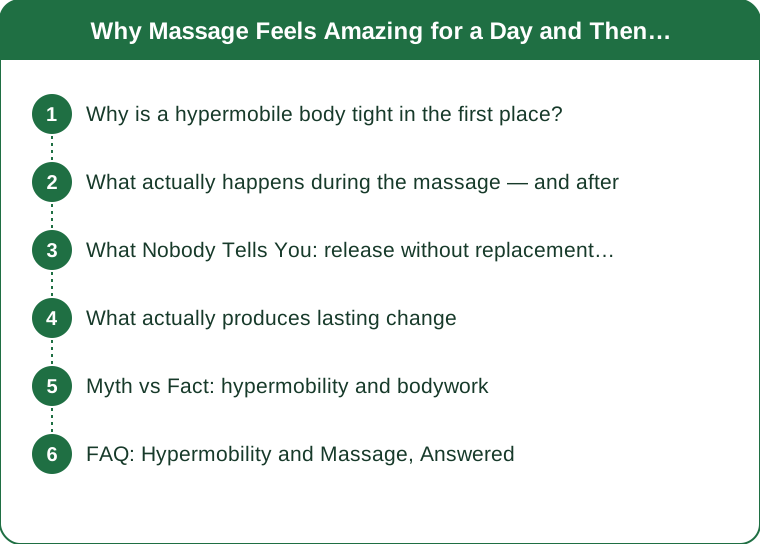
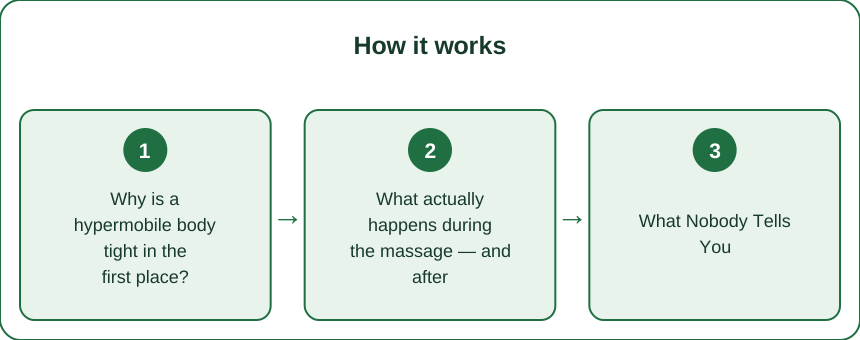
Why is a hypermobile body tight in the first place?
This is the paradox that confuses almost everyone, including some clinicians.
Hypermobility means your connective tissue is more extensible than average. Ligaments — the passive structures that limit how far a joint can travel — do less of their job.
But joints still need limits. So the body recruits the only other system available: muscle.
Muscles around a hypermobile joint end up holding low-grade tension almost continuously, acting as active brakes where passive brakes are insufficient. This is not dysfunction. It is a sensible solution to a real problem, and it is why hypermobile people so often describe themselves as flexible but permanently tight.
The tightness you feel is not shortened muscle. It is muscle that is switched on, and it is switched on for a reason.
What actually happens during the massage — and after
A good massage reduces muscle tone through several routes: mechanical pressure, altered input to the nervous system, and a general shift toward a parasympathetic state.
For an hour and for some hours afterwards, your nervous system turns the guard down. That is the relief. It is real, and it feels wonderful.
Then your body goes back to doing things. You stand up, walk, carry a bag, sit at a desk, and your joints report back that they are less supported than they were this morning.
The nervous system responds exactly as it should: it turns the guard back on. Often slightly higher than before, because the recent instability registered as a small threat.
This is why hypermobile people frequently report the specific pattern of feeling amazing for a day and slightly worse on day three. The rebound is not a failure of the massage. It is the system doing precisely what it is designed to do.
What Nobody Tells You: release without replacement is a net loss
Here is the uncomfortable part.
If muscular tension is providing 30 percent of a joint’s stability and you remove it without adding anything, that joint is now less stable than it was before you walked in.
For a few hours you feel great, because reduced tone genuinely feels good and because the discomfort of overworking muscles is gone. But the joint is doing more travelling than it should, the surrounding tissue is being loaded in ways it is not prepared for, and the nervous system is watching.
This is the mechanism behind a pattern many hypermobile people describe but struggle to explain: a really deep massage sometimes leaves them achy or unstable for two or three days.
The rule that changes everything: never release without replacing. If you have a session that reduces tone significantly, spend the next 48 hours doing more low-load stability work, not less. Give the joint a new source of support before it goes hunting for the old one.

What actually produces lasting change
Isometric holds, in the ranges you can control. Hypermobile joints respond exceptionally well to isometrics — holding a position under load without moving through range. Think 20 to 45 second holds, repeated three to five times. Wall sits, side planks with a bent knee, glute bridge holds, prone Y holds for the mid-back.
Strength through the middle range, not the end range. Your end range is not the problem; your ability to control the middle is. Half-range work with good control beats full-range work with a joint that dumps into its limit.
Frequency over intensity. Three short sessions a week beats one long one, because the nervous system needs repeated evidence that the joint is supported, not a single heroic effort.
Time, honestly. Meaningful change in how a hypermobile joint feels takes 8 to 12 weeks of consistent work. The first three weeks often feel like nothing is happening. Week six is usually when people notice the tightness is arriving later in the day rather than by 10 a.m.
And massage still has a place — as maintenance alongside the strength work, timed after a hard week rather than instead of training, and generally lighter than you think you need.
Myth vs Fact: hypermobility and bodywork
Myth: If it feels tight, it needs stretching. Fact: In a hypermobile body, stretching a protectively toned muscle usually buys a few minutes and costs you stability. This is the single most common mistake in this population.
Myth: Deeper pressure means better results. Fact: Hypermobile tissue is often more sensitive and slower to settle. Lighter, slower work with less end-range joint mobilisation frequently produces a longer-lasting result.
Myth: The tightness will go away once you strengthen enough. Fact: It reduces substantially, and it arrives later in the day, and it stops being painful. Some baseline muscular guarding around hypermobile joints is normal and appropriate. The goal is manageable, not absent.
Myth: Foam rolling is different from massage. Fact: Mechanically similar enough that the same logic applies. Useful for a warm-up nudge, not a solution to protective tone.
Myth: You should tell the therapist to avoid the tight spots. Fact: You should tell them you are hypermobile, that you prefer moderate pressure, and that you would rather they avoid aggressive end-range joint mobilisation and stretching. Most good therapists change their whole approach with that information.
FAQ: Hypermobility and Massage, Answered
Should I stop getting massages entirely?
No. Change the timing and the intent. Book it as recovery after a demanding week rather than as a fix for tightness, ask for moderate pressure, and do your stability work the following two days.
How do I explain this to a massage therapist?
Say: I am hypermobile, so please use moderate pressure, avoid stretching me into end range, and skip joint mobilisations. Most therapists have training in this and appreciate being told.
Is dry needling or cupping any different?
Same principle. They reduce tone effectively; they do not change why the tone was there. Some hypermobile people find them useful adjuncts, and some find them destabilising. Trial one at a time and give it a week before judging.
This is general information, not medical advice. New joint instability, frequent subluxations, or pain that changes character are reasons to see a physiotherapist experienced with hypermobility.
TL;DR:
- In hypermobile bodies, tightness is usually muscle doing a ligament’s job — protective tone, not shortened tissue.
- Massage removes the tone but not the reason for it, so the nervous system rebuilds it within 12 to 48 hours, sometimes higher than before.
- Releasing without replacing temporarily makes the joint less stable, which is why a deep session can leave you achy for days.
- Lasting change comes from isometric holds, mid-range strength, three short sessions a week, and 8 to 12 weeks of patience.
- Keep massage as maintenance, ask for moderate pressure and no end-range stretching, and do stability work in the 48 hours afterwards.
Your muscles are not being difficult. They are holding a job they were never designed for, and the only way to let them put it down is to hire someone else.
Keep Reading
This article is for general informational purposes only and is not medical advice. Always consult a qualified health professional for guidance specific to you.