Why Your Joints Feel Looser on Warm Days and Stiffer on Cold Ones
Quick Answer: Connective tissue is viscoelastic, which means its stiffness depends on temperature. Warm tissue deforms more easily, so on a warm day a hypermobile joint reaches end range sooner and with less resistance - which feels good and is where a lot of overstretching injuries happen. Cold tissue is stiffer, so a cold morning feels restricted and unstable at the same time, because your usual proprioceptive cues have changed. Neither state is a problem on its own. The problem is using the same session in both.
Warm days need more control work and less range. Cold days need a longer warm-up and lower expectations for the first twenty minutes.
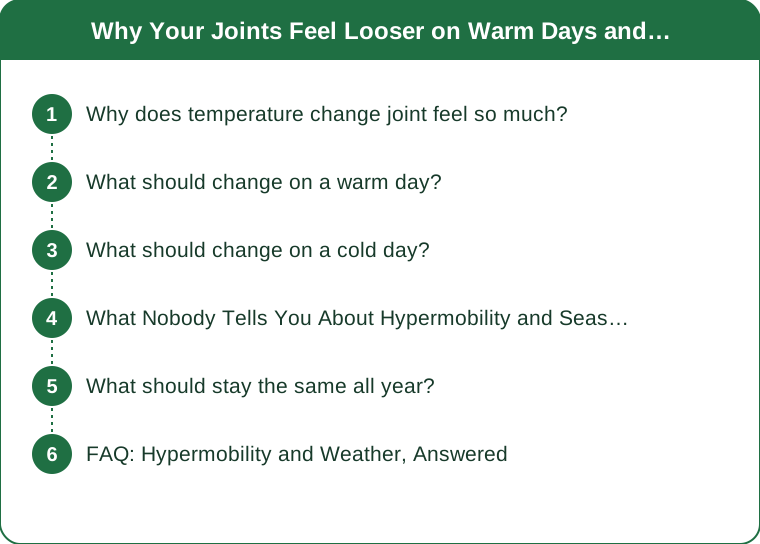
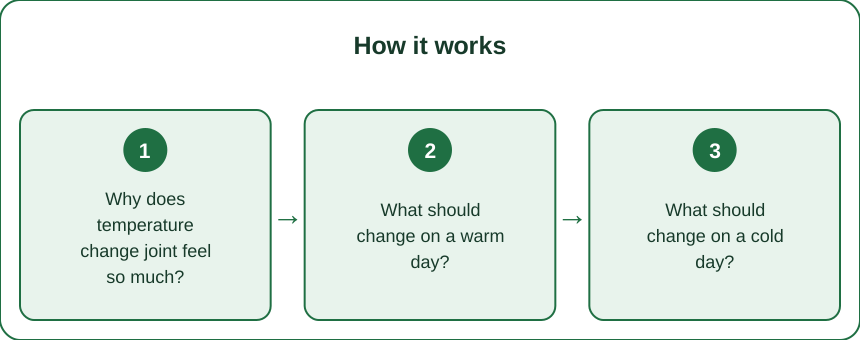
Why does temperature change joint feel so much?
Collagen is viscoelastic: it behaves differently depending on temperature and on how fast you load it. Warmer tissue is more compliant, cooler tissue is stiffer, and hypermobile people sit at a point on that curve where small changes are very noticeable.
More compliance means less passive restraint. Hypermobile joints rely more on muscular control and less on ligamentous restraint than average, and a warm day removes some of the restraint that was already limited.
Cold does the reverse and it is not entirely good news. Stiffer tissue feels more stable, but proprioception - your sense of joint position - is worse when tissue is cold, and hypermobile people already have measurably reduced joint position sense.
So warm days feel good and are riskier; cold days feel bad and are also riskier, for different reasons. That is genuinely annoying and it is worth knowing.
Humidity and barometric pressure get blamed and the evidence there is much weaker than for temperature. Temperature is the variable with a clear mechanism.
And your own body temperature matters more than the air. A cold morning after a warm shower and a proper warm-up is a different tissue state from a cold morning straight out of the door.
What should change on a warm day?
Reduce range, increase control. Warm tissue lets you go further, and going further is not the goal for a hypermobile joint. Working within range with more load and slower tempo is.
Be specific about stretching: mostly do not. Passive stretching feels excellent to hypermobile people and generally makes things worse over time. If the joint already reaches end range easily, taking it further is adding to the problem you are trying to solve.
Use isometrics at mid-range. Holds at joint angles you can control build the active stability that hypermobile joints are short of.
Watch end-of-range in yoga and pilates specifically. Warm room plus warm tissue plus a cue to go deeper is the exact combination that produces subluxations and irritated joints.
Add tempo. Three seconds down on any lift is a large increase in control demand at no increase in load, and it is the single most useful adjustment for hypermobile lifters.
And check joint position in a mirror or on video. On warm days the position that feels neutral is often past neutral, because your position sense is calibrated against resistance you are not getting.
What should change on a cold day?
Warm up twice as long as you think you need. Fifteen minutes is not excessive on a cold morning, and rushing it is where the tweaks happen.
Start with movement, not stretching. Circulation and tissue temperature are what you are after. Joint circles, easy cycling, brisk walking.
Expect the first sets to feel wrong and do not read into them. Poor position sense in cold tissue means everything feels slightly off, and it resolves as you warm.
Dress for the whole session including rest periods. Cooling down between sets is a real problem in an unheated garage or a cold studio, and layers you can remove are better than trying to warm up once.
Delay the technical work. Balance drills, single-leg work, and anything demanding fine control belong in the middle of a cold-day session, not at the start.
And do not skip training because it feels stiff. Movement is the intervention for morning stiffness, and hypermobile people who train through cold months consistently report the winter being easier than those who reduce.
What Nobody Tells You About Hypermobility and Seasons
Fatigue tracks the weather too. Many hypermobile people report noticeably higher fatigue in cold months, and the amount of muscular work required to stabilise joints in stiffer, less proprioceptive conditions is a plausible part of it.
Autumn is the highest-risk transition, not winter. Swinging between a warm afternoon and a cold morning within one week means your tissue state is inconsistent while your training programme is not.
Sleep position matters more as it gets cold. People curl up in cold bedrooms, and sustained end-range positions overnight are a common cause of morning joint pain that gets blamed on the previous day’s training.
Compression clothing helps more than it should. The mechanism is likely proprioceptive rather than mechanical, and hypermobile people often report a real difference from compression leggings or sleeves in cold weather.
Standing still is harder than moving. Cold weather often means more standing around - bus stops, sidelines, queues - and static standing is one of the more demanding things you can ask a hypermobile joint to do.
And the ankle is the first joint to complain. Ankles do the most position-sensing work and lose the most from cold tissue, which is why rolled ankles cluster in autumn.
What should stay the same all year?
Strength work, every week, non-negotiable. Muscular control is the primary stabiliser for a hypermobile joint and it is the only variable you actually control.
Full range of motion under load, not passive stretch. Loaded end-range work builds control at the ranges you already have. Passive stretching just adds range you cannot control.
Single-leg and single-arm work. Balance and unilateral loading train position sense directly.
Slow progression. Hypermobile people frequently tolerate a session fine and feel it three days later, so a two-week evaluation window is more honest than a next-day one.
Track flares against variables you can measure - sleep, temperature, session type, standing hours. Patterns emerge within a couple of months and they are usually actionable.
This is general information, not medical advice. New instability, joint dislocation, or significant pain warrants assessment by a physiotherapist or doctor familiar with hypermobility rather than a training adjustment.
FAQ: Hypermobility and Weather, Answered
Is it bad to train when my joints feel loose?
Not bad, but adjust: reduce range, slow the tempo, and avoid end-range positions. Loose days are control days.
Should I stretch if I feel stiff in the morning?
Move rather than stretch. Circulation and gentle range work address morning stiffness; passive stretching adds range you already have too much of.
Do compression leggings actually help?
Many hypermobile people report they do, likely through improved proprioceptive feedback. It is a cheap thing to test on yourself.
Why am I more tired in winter?
Stabilising joints with less passive restraint and worse position sense takes muscular work. Higher cold-weather fatigue is commonly reported and worth planning around.
Should I train less in autumn?
No - train more consistently and warm up longer. Reduced training in cold months tends to make the following spring harder.
This is general information, not medical advice.
TL;DR:
- Connective tissue is viscoelastic - warm tissue is more compliant, cold tissue stiffer, and hypermobile joints feel both changes clearly.
- Warm days feel great and carry more overstretch risk; cold days feel stiff and carry more risk from poor position sense.
- On warm days: less range, slower tempo, mid-range isometrics, and no passive stretching.
- On cold days: warm up for fifteen minutes, dress for rest periods too, and put technical work in the middle of the session.
- Strength and single-limb control work stay constant all year - muscular control is the stabiliser you actually control.
Autumn is the riskiest window because tissue state swings week to week while the programme does not.
See It in Motion
Seen here: Super High Waist Embossed Yoga Leggings with Inner Pocket — shop it on bubblelime.com
Keep Reading
This article is for general informational purposes only and is not medical advice. Always consult a qualified health professional for guidance specific to you.