Why Cold Weather Changes How Hypermobile Joints Feel
Quick Answer: Cold reduces tissue compliance and blunts proprioceptive feedback, which for hypermobile joints means both more stiffness and more instability at the same time. The answer is longer warm-ups, deliberate warmth at the joints, and more stability work rather than more stretching — stretching a cold hypermobile joint is the fastest route to a bad week.
It is a strange combination to explain to people. You are more stiff and less stable. Your shoulders feel tight and also slip more easily. The mornings take longer and the evenings are less reliable.
Hypermobile bodies respond to cold weather in a way that is genuinely different from how other bodies do, and the reason is that cold acts on two systems you already depend on more than most people.

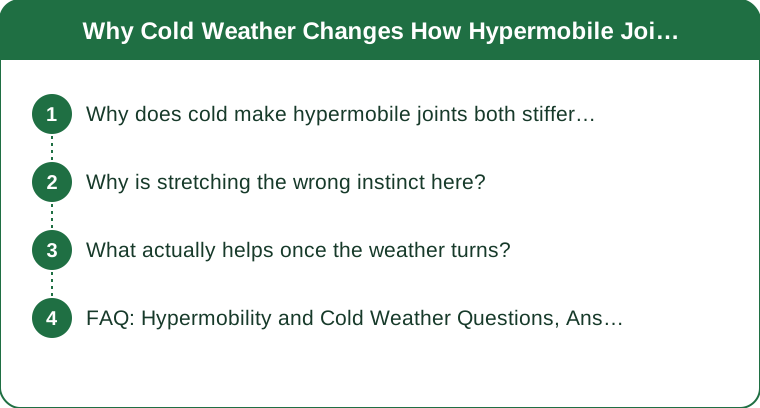
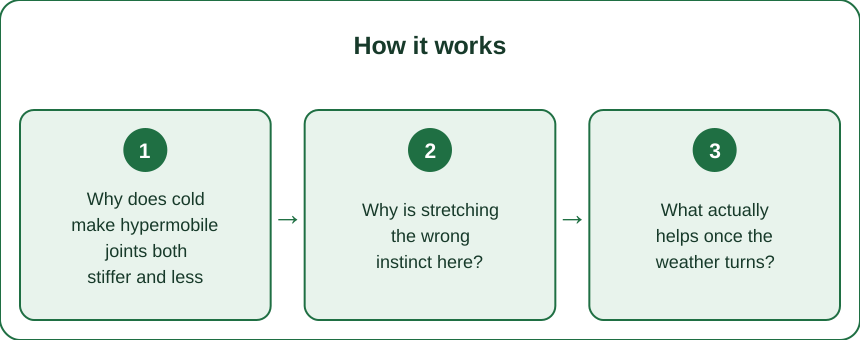
Why does cold make hypermobile joints both stiffer and less stable?
The two effects come from different tissues and they compound.
Stiffness comes from reduced tissue compliance. Connective tissue viscosity increases as temperature falls — collagen and the surrounding matrix simply move less easily when cold. Everyone experiences this; for a hypermobile person it is more noticeable because the contrast with your usual range is greater.
Instability comes from proprioception. This is the more important half. Proprioceptive feedback — your sense of where your joints are in space — depends on receptors in muscle, tendon, and joint capsule, and their signaling accuracy degrades measurably in cold tissue.
Hypermobile joints already rely more heavily on active muscular control and proprioceptive correction, because the passive restraints — ligaments and capsule — provide less end-range protection than they do in a typical joint. When cold blunts the feedback that your active control depends on, you lose stability at exactly the joints that had the least margin.
That is why autumn brings more subluxations, more clumsiness, and more of the specific experience of a joint moving somewhere you did not intend before you noticed it happening.
Why is stretching the wrong instinct here?
Because the stiffness you feel is not the problem you have.
A hypermobile joint that feels tight is usually reporting protective muscular guarding, not short tissue. The muscles around an unstable joint increase tone to compensate for passive restraint they cannot rely on. That guarding is doing a job.
Stretching into it does three unhelpful things: it temporarily reduces the guarding your joint was depending on, it moves you further toward end range where hypermobile joints are least protected, and it provides genuine short-term relief that reinforces the habit.
This is the loop that keeps a lot of hypermobile people stuck for years — stretch, feel better for an hour, feel tighter tomorrow, stretch more.
What replaces it:
- Isometric holds at mid-range, which build stability without visiting end range
- Controlled articular rotations — slow, active circles through a range you control, rather than passive stretching
- Loaded mobility, where you add light resistance through a range so the nervous system learns to control it
- Heat before movement rather than stretching for the sensation of release
If a stretch feels amazing and you have hypermobility, that is often a signal to be more careful, not less.

What actually helps once the weather turns?
Practical, in order of impact.
Warm the joints, not just the room. Local warmth matters more than ambient temperature for tissue compliance and proprioceptive accuracy. Long sleeves, leggings under trousers, wrist warmers, and warm socks are unglamorous and genuinely effective. Compression garments serve double duty here — the warmth plus the enhanced proprioceptive input from skin pressure is why many hypermobile people find compression more useful in winter than in summer.
Double your warm-up. Where a summer warm-up might be five minutes, a cold-weather one wants twelve to fifteen, and it should be movement rather than stretching. Joint circles, light dynamic work, gradually increasing range.
Move more often, in smaller amounts. Long static periods are harder in cold weather, and hypermobile bodies stiffen faster in stillness. Moving every 30 minutes does more than a single long session.
Increase stability work seasonally. If you do two sessions of stability and strength work a week in summer, three is a better winter number. This is the direct counter to reduced proprioceptive input — better muscular control compensates for worse sensory feedback.
Watch your sleep position. Cold nights lead to curled sleeping positions that put joints at end range for hours. A warmer bed and a pillow between the knees prevents a lot of the morning symptom load that gets blamed on the weather itself.
Manage the fatigue honestly. Cold weather increases the energy cost of everything, and fatigue reduces proprioceptive accuracy further — creating a real loop where tired means less stable means more effortful means more tired.
This is general information, not medical advice. If you have a diagnosed connective tissue disorder, work with a physiotherapist experienced in hypermobility for individualized programming — generic mobility advice is frequently wrong for these bodies.
FAQ: Hypermobility and Cold Weather Questions, Answered
Does cold weather actually make hypermobility worse, or does it just feel worse?
Both, in different ways. The underlying laxity does not change — that is structural. But the functional stability you have available genuinely does decrease, because it depends on proprioception and muscular control, and both degrade in cold tissue. So the experience of being less stable is real, not perceptual.
Should I wear braces more in winter?
Situationally, and be careful about the default. Bracing provides useful proprioceptive input and mechanical support, but continuous use can reduce the muscular control you want to build. Most physiotherapists suggest using support for demanding activities and going without for daily movement. Compression sleeves are a gentler option that gives sensory input without much mechanical restriction.
Why are my mornings so much worse in autumn?
Overnight is the longest period of stillness and the coldest part of the day, so you accumulate maximum stiffness with minimum movement. A warm shower before anything else, ten minutes of gentle movement in bed before standing, and a warmer sleeping environment address most of it.
TL;DR:
- Cold reduces tissue compliance and blunts proprioception, which makes hypermobile joints stiffer and less stable at the same time.
- The tightness is usually protective muscle guarding, not short tissue — stretching into it removes the stability you were relying on.
- Replace stretching with isometrics, controlled articular rotations, and loaded mobility.
- Warm the joints directly; compression garments give warmth plus proprioceptive input.
- Increase stability sessions seasonally, warm up for 12 to 15 minutes, and move every 30 minutes rather than in one block.
Keep Reading
This article is for general informational purposes only and is not medical advice. Always consult a qualified health professional for guidance specific to you.