Hypermobility and Bruising: Why You Mark So Easily
Quick Answer: Collagen supports the tiny blood vessels in your skin as well as your joints. When collagen is more elastic, those vessels are less well braced, so minor knocks rupture them more easily and the resulting bruises spread further and take longer to clear. It is a recognised feature of hypermobility spectrum conditions, and it is worth mentioning to a doctor once rather than worrying about every mark.
This is general information, not medical advice.

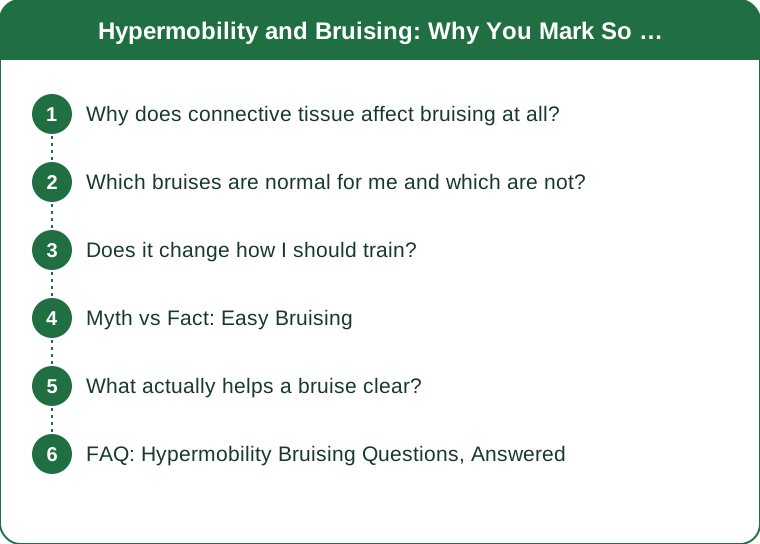
Why does connective tissue affect bruising at all?
Capillaries do not stand up on their own. They sit within a scaffold of collagen and elastin that holds them in place and limits how much they deform under pressure. Softer scaffolding means more deformation for the same impact.
Skin thickness is part of it. Many hypermobile people have skin that is measurably softer and more stretchy, which means less padding between an impact and the vessels underneath.
Bruises spread more because the surrounding tissue is more permissive. Blood released under the skin travels along the path of least resistance, and looser tissue offers less resistance, which is why a small knock can produce a large mark.
Clearance can be slower. Reabsorbing a bruise depends partly on local circulation and lymphatic drainage, and both can be less efficient in more lax tissue, which is why yours may still be visible after two weeks.
And you genuinely do knock into more things. Proprioception — knowing where your limbs are without looking — is commonly reduced with hypermobility, so the number of small impacts per week is higher before any tissue difference is considered.
Which bruises are normal for me and which are not?
A pattern of small bruises on shins, forearms, hips and outer thighs is the classic hypermobile picture. Those are the parts of you that meet door frames, desks and bed corners.
Bruises you cannot explain at all are also common and are usually knocks you did not register at the time rather than spontaneous bleeding.
What is worth a conversation with a doctor: bruises on the trunk or back with no plausible cause, bruises that appear alongside frequent nosebleeds or bleeding gums, bleeding that takes unusually long to stop after a cut or dental work, or a sudden change in your normal bruising pattern.
Heavy periods alongside easy bruising is worth mentioning together, because the combination points toward things that are simple to test for and simple to treat.
Medication and supplements matter. Regular ibuprofen or aspirin, fish oil at high doses, and some other supplements all affect clotting or platelet function, and people frequently forget to mention them.
Get it assessed once properly and then stop auditing yourself. A baseline conversation and, if your doctor thinks it useful, a simple blood count is far more reassuring than years of low-level worry about individual marks.
Does it change how I should train?
Not much, and less than people expect. Easy bruising is a cosmetic and diagnostic issue rather than a training restriction in most cases.
Equipment contact is where it shows up. Barbell work across the hips, front rack position across the collarbones, and kettlebell contact on the forearm all produce marks that look alarming and are not.
Padding solves most of it. A barbell pad for hip hinge work, longer sleeves for kettlebell work and shin guards for anything involving box contact remove the majority of visible bruising without changing the training.
Technique is the better fix where it applies. A kettlebell that lands on the forearm is a kettlebell that was thrown rather than guided, and fixing that improves the lift as well as the bruise.
Contact sports need a genuine conversation rather than a blanket rule. Many hypermobile people participate safely; some find the joint instability a bigger issue than the bruising.
Do not use bruising as a training intensity gauge. It reflects contact and tissue properties, not effort or progress.

Myth vs Fact: Easy Bruising
Myth: Easy bruising means you are deficient in vitamin C. Fact: Severe vitamin C deficiency does cause bruising, and it is rare in people eating any reasonable diet. Supplementing when you are not deficient does nothing for bruising caused by tissue laxity.
Myth: It means something is wrong with your blood. Fact: In hypermobility it is far more often a tissue property than a clotting problem. Clotting disorders exist and are worth ruling out once, but they are not the usual explanation.
Myth: Arnica makes bruises heal much faster. Fact: The evidence is weak and inconsistent. Cold in the first day and gentle movement afterwards do more, and both are free.
Myth: You should avoid weight training if you bruise easily. Fact: Strength training is one of the most useful things hypermobile people can do, because muscular support partly compensates for what the connective tissue does not provide. Pad the contact points and carry on.
Myth: Bruising gets worse with age regardless. Fact: Skin does thin over time and bruising does become more common, but a sudden change at any age is worth mentioning rather than accepting as inevitable.
What actually helps a bruise clear?
Cold for the first 12 to 24 hours limits how much blood escapes into the tissue. Twenty minutes on, wrapped rather than direct, repeated a few times.
Elevation helps for limbs in the first day, for the same reason.
Gentle movement afterwards helps more than rest. Circulation clears the pooled blood, and immobilising a bruised limb slows the process.
Warmth after the first day encourages local blood flow and is more comfortable than cold at that stage.
Compression sleeves are useful for people who bruise on the forearms or shins regularly, both as protection and as support afterwards.
And prevention beats treatment. Better lighting in hallways, moving the coffee table, and being deliberate in tight spaces sound trivial and account for a surprising share of unexplained bruises in hypermobile people, because reduced proprioception is doing exactly what you would expect it to do.
FAQ: Hypermobility Bruising Questions, Answered
Is easy bruising part of the diagnostic criteria for hypermobility?
Skin features including easy bruising appear in the criteria for hypermobile Ehlers-Danlos syndrome and are commonly noted in hypermobility spectrum disorders, alongside joint findings. It is a supporting feature rather than a standalone one.
Should I take a supplement for it?
Not without a reason. Correct any actual deficiency your doctor identifies, and be aware that high-dose fish oil and some herbal supplements can make bruising worse rather than better.
Do bruises mean my training is damaging me?
No. Marks from equipment contact tell you where things touched you, not how hard you worked or whether the tissue underneath was harmed.
TL;DR:
- Collagen supports skin capillaries as well as joints, so laxer tissue bruises more easily and spreads further.
- Reduced proprioception means more small impacts you never registered.
- Get it assessed once — especially alongside heavy periods, nosebleeds or slow-stopping cuts — then stop auditing every mark.
- Pad barbell, kettlebell and box contact points; keep strength training, which genuinely helps.
- Cold and elevation day one, gentle movement and warmth afterwards.
The bruise is reporting your tissue, not your training.
Keep Reading
This article is for general informational purposes only and is not medical advice. Always consult a qualified health professional for guidance specific to you.