Why Hypermobility Causes Genuine Fatigue That Has Nothing to Do With Being Out of Shape
Quick Answer: Hypermobile joints need active muscular effort to hold positions that a tighter joint holds passively through its own structure. That extra stabilization work runs all day — standing, sitting, holding a phone — not just during exercise, so it compounds into real fatigue across 16 waking hours. It’s a mechanical cost, not a fitness failure. This is general information, not medical advice.
You did roughly nothing today. A grocery run, some emails, one load of laundry. And you’re wrecked.
Meanwhile someone with the same schedule feels fine, which is where the unhelpful explanations start arriving: you should do more cardio, you’re deconditioned, you just need to push through.
If you’re hypermobile, there’s a specific mechanical reason this happens, and it isn’t about effort.

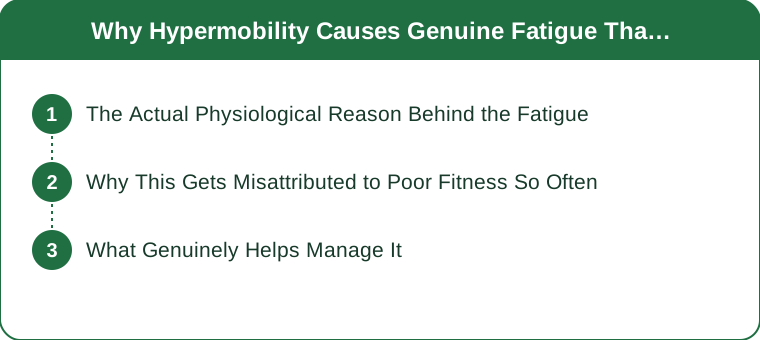
Why does hypermobility cause fatigue?
Because your muscles are doing a job that most people’s connective tissue does for free.
In a typical joint, ligaments and capsule are tight enough to hold the bones in position passively. Standing still costs almost nothing. In a hypermobile joint, that connective tissue is laxer — so holding the same position requires active muscular work. Small muscles, firing constantly, to keep a knee from drifting into hyperextension or a shoulder from sitting slightly out of its socket.
Now multiply that by the whole day.
That’s the part people miss. This isn’t a workout cost that ends when the workout does. It’s happening while you stand in line, sit at a desk, hold a coffee cup, walk to the car. Sixteen waking hours of low-level stabilization work that a non-hypermobile body simply doesn’t pay for.
It also stacks with poor proprioception. Hypermobile joints give less reliable position feedback, so the nervous system compensates by monitoring more actively — which is its own quiet drain.
The reframe: the fatigue is a real, continuous, physiologically grounded cost. It’s not low effort, and it’s not in your head.

Why does everyone assume it’s being out of shape?
Because fatigue that doesn’t match visible exertion has one very familiar explanation, and people reach for it automatically.
The pattern is predictable: someone looks fine, isn’t doing much, and reports exhaustion. The default frame available to most people — including a lot of well-meaning providers — is fitness or effort. So the advice arrives as “more cardio” or “build up your endurance.”
That advice isn’t malicious. It’s just aimed at a different mechanism. And believing the wrong cause is expensive, because it sends you toward generic conditioning programs that add stabilization demand without addressing the stabilization deficit, which often makes the fatigue worse rather than better.
Naming the actual cause matters, mostly because it changes what you try next.
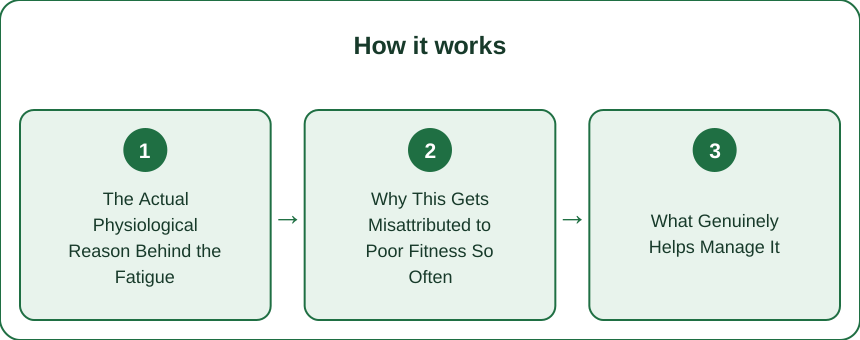
What actually helps?
Three things, in rough order of impact.
Targeted stability strength around your loosest joints. Not general cardio — specific strength for the muscles doing the stabilizing job. Glute medius for hips, rotator cuff and scapular work for shoulders, deep neck flexors if your neck is a problem area. The point is to make each ordinary movement cost less over time. Two or three short sessions a week, 20 minutes, with mid-range work and controlled tempo. Expect to notice a difference at around 8–12 weeks, not 8–12 days.
Pace the whole day, not just the workout. This is the piece people skip. If the fatigue source is continuous, the rest has to be distributed too. Practical version: sit down for 5 minutes every hour or so, break errands across two days instead of one, and stop treating a rest day as “no gym” when the actual load is life. Some people find external support — a compression sleeve, a proper chair, a rolling bag instead of a shoulder bag — buys back a surprising amount of daily budget.
Get someone who knows the mechanism. A physical therapist familiar with hypermobility, hEDS, or HSD will program differently from one who isn’t. It’s worth asking directly on the phone: “do you work with hypermobile patients?”
What Nobody Tells You
The boom-and-bust cycle is the main trap. Good day arrives, you do everything you’ve been putting off, and you pay for it for three days. Over months, this pattern does more damage than the underlying fatigue does. Capping your good days at about 70% of what you feel capable of is deeply annoying advice that works remarkably well.
Fatigue can lag by 24–48 hours. The crash often doesn’t arrive the same evening, which makes it genuinely hard to connect cause and effect. A simple log — activity plus energy score out of 10, daily, for a month — usually reveals the pattern faster than any amount of introspection.
Progress feels like nothing for a while, then feels like everything. Stability strength is slow. The first sign usually isn’t “I have more energy,” it’s “that thing I used to dread is now just a normal errand.”
When to see a professional: if fatigue is severe, worsening, or comes with dizziness on standing, a racing heart, digestive symptoms, or frequent joint dislocations, get it looked at. Hypermobility often travels with conditions like POTS and dysautonomia that have their own treatments, and fatigue also has plenty of unrelated causes worth ruling out. This article is general information, not a diagnosis or a treatment plan.
FAQ
Is hypermobility fatigue real or psychological?
It’s a real, mechanical cost. Lax connective tissue means muscles must actively hold joint positions that a tighter joint holds passively, and that work continues all day rather than only during exercise. The exhaustion is a downstream effect of continuous muscular effort, not a mood or motivation issue.
Will getting fitter fix hypermobility fatigue?
General cardio usually doesn’t, and can make things worse if it adds load without adding stability. What helps is targeted strength around the specific joints that are loosest, built slowly, plus pacing across the whole day. Fitness matters — but the kind of fitness matters more.
Why am I more tired than people who do far more than me?
Because you’re paying an energy cost they aren’t. Their joints hold position structurally; yours hold position muscularly. Two people can do the same errands and have very different bills at the end of the day, and that difference is mechanical, not motivational.
TL;DR:
- Hypermobile joints need active muscle work to hold positions other joints hold passively.
- That cost runs across all 16 waking hours, not just during exercise — which is why it compounds.
- It gets misread as poor fitness because that’s the most familiar explanation available.
- What helps: targeted stability strength around your loosest joints, pacing spread through the whole day, and a PT who knows hypermobility.
- Watch for boom-and-bust; cap good days at about 70%.
- See a professional if fatigue is severe or comes with dizziness, palpitations, or dislocations. General information, not medical advice.
Keep Reading
This article is for general informational purposes only and is not medical advice. Always consult a qualified health professional for guidance specific to you.