Why Hypermobility Causes a Specific Kind of Exhaustion That Rest Alone Doesn't Fix
Quick Answer: Hypermobility-related fatigue isn’t ordinary tiredness. Loose ligaments provide less passive joint support, so your muscles do continuous stabilizing work all day — plus your nervous system works harder to track where your joints are. That’s a real, ongoing energy cost, which is why sleep alone doesn’t clear it.
You slept eight hours. You didn’t do anything unusual yesterday. And by 2 p.m. you’re running on empty in a way that “get more rest” has never once fixed.
If you have joint hypermobility, this pattern has an actual mechanism behind it. It isn’t in your head, and it isn’t a discipline problem.
This is general information, not medical advice.

Why Does Hypermobility Cause Fatigue That Rest Doesn’t Fix?
Because the energy cost is continuous, not episodic.
In a joint with typical ligamentous support, the ligaments hold position passively. It’s structural — it costs nothing. In a hypermobile joint, that passive support is reduced, so muscles take over the job actively, and active work costs energy.
That’s the crucial part: this isn’t happening only when you exercise. It’s happening while you stand at the counter, while you sit at a desk, while you hold your phone. Every waking hour, dozens of joints, low-level muscular effort that never switches off.
Ordinary fatigue comes from a defined expenditure and resolves with a defined rest. This is a raised baseline cost. Rest reduces it; rest doesn’t eliminate it, because the demand resumes the moment you’re upright again.
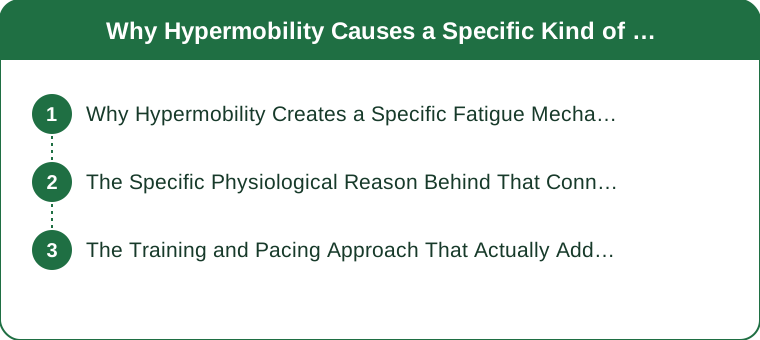
What’s the Physiological Reason Behind the Connection?
Three layers, stacking.
1. Continuous compensatory stabilization. Covered above, and it’s the largest single contributor. Hypermobile joints need meaningfully more active muscular effort throughout ordinary daily movement than joints with typical ligament support.
2. Increased proprioceptive workload. Ligaments don’t just hold joints together — they feed the nervous system information about where the joint is. Looser ligaments provide weaker passive feedback, so the nervous system has to work harder to monitor joint position. Cognitive and neural effort is real effort, and this one shows up as the mental fog that so often accompanies the physical tiredness.
3. Subluxation events cost extra. Minor instability episodes — a joint slipping slightly and correcting — each trigger their own protective muscular response. Individually small, they add up across a day, and they land on top of the elevated baseline rather than replacing it.

What Nobody Tells You About Hypermobility Fatigue
Nobody tells you that the good days are the trap. Feeling capable leads to doing everything you postponed, which produces a crash that can last days. The pattern is so common it has a name in chronic illness communities — boom and bust — and hypermobility fits it precisely.
Nobody tells you that being “flexible” is often the opposite of the problem. People hear hypermobility and think advantage. The range isn’t the issue; the lack of stability at the end of that range is.
Nobody tells you that the fog and the fatigue are related. The proprioceptive workload means the nervous system is genuinely busier, so the tiredness often has a cognitive flavor rather than a purely muscular one.
And nobody tells you that generic fatigue advice can actively backfire. “Push through it” and “just build up your cardio” are reasonable defaults for ordinary deconditioning and poor advice for a stability problem.
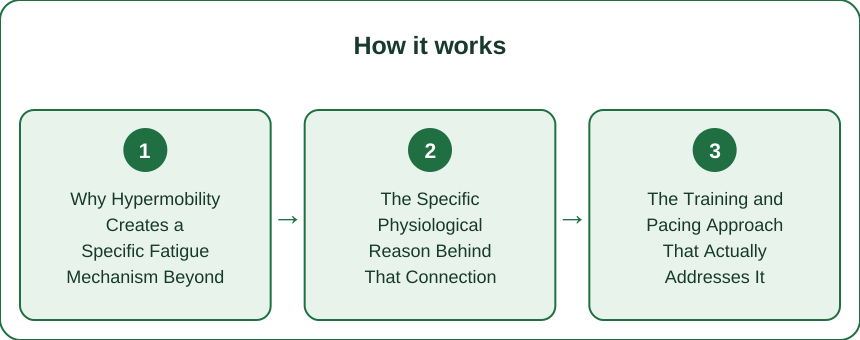
What Training and Pacing Approach Actually Helps?
Build targeted strength around hypermobile joints. This is the one that changes the underlying equation rather than managing around it. Stronger stabilizing muscles do the same job at a lower relative effort, which lowers the baseline cost over time. Progress slowly and in controlled ranges — the goal is stability and control, not more flexibility, which you already have plenty of.
Pace proactively, not reactively. Schedule rest before you need it, distributed through the day, rather than resting once fatigue has already arrived. Reactive rest is always chasing a deficit. Short, planned breaks — even 5–10 minutes at set points — tend to work better than one long recovery after a crash.
Work with someone who knows hypermobility specifically. A physical therapist familiar with hypermobility will program differently than one working from a generic template: controlled ranges, stability emphasis, careful progression, and attention to which joints actually need support. This is worth the search.
Support what you can passively. Some people find compression or well-fitted supportive clothing genuinely helps reduce the sense of joint looseness through the day. Firm high waist compression leggings do this for hips and knees for a lot of people — a small, low-cost thing to test, not a treatment.
When to see a professional: persistent unexplained fatigue always deserves a medical workup, since hypermobility doesn’t rule out other causes and often coexists with conditions worth identifying. Bring specifics — what you did, what it cost, how long recovery took. This is general information, not medical advice.
FAQ
Does hypermobility fatigue improve with strength training?
For many people, yes — reducing the stabilization burden lowers the ongoing cost. Progress needs to be gradual and stability-focused, though, and early sessions can temporarily increase fatigue before things settle.
Why am I more tired after a normal day than after a rest day?
Because the cost accumulates with upright, active hours rather than with intensity. A day of ordinary standing and moving can be more expensive than a shorter, harder session.
Should I stretch if I’m already flexible?
Generally, stretching into more range isn’t the priority and can aggravate instability. Most hypermobility-informed programs emphasize strength and control instead. Ask a PT who knows the condition.
TL;DR
- The fatigue is real and mechanistic — continuous muscular stabilization replacing absent passive ligament support.
- Two amplifiers: higher proprioceptive workload for the nervous system, plus energy costs from minor subluxation events.
- Rest alone doesn’t fix it because the cost is a raised baseline, not a one-off expenditure.
- What helps: targeted stability strength, proactive distributed pacing, and a clinician who knows hypermobility specifically.
Keep Reading
This article is for general informational purposes only and is not medical advice. Always consult a qualified health professional for guidance specific to you.