Why Reformer Pilates Works Differently for Hypermobile Joints
Quick Answer: Reformer springs give a hypermobile joint an external resistance boundary that mat Pilates can’t — the spring, not just your muscles, decides where the movement stops. For hypermobile bodies that usually means choosing a heavier spring than the exercise normally calls for, working in the middle of your range instead of the end, and skipping the maximum-stretch positions entirely.
If you’re hypermobile, you’ve probably had the experience of finishing a mat Pilates class feeling great and waking up the next day feeling looser and less stable, not stronger. That’s not in your head.
Mat work sets the limit of a movement with muscular control alone. A hypermobile joint is bad at knowing where it is in space, so it drifts toward its end range without noticing — and the class ends up rehearsing the exact pattern you’re trying to correct.
A reformer changes the equation, and the reason is mechanical.
How is reformer Pilates different from mat for hypermobility?
Three things change, and all three matter.
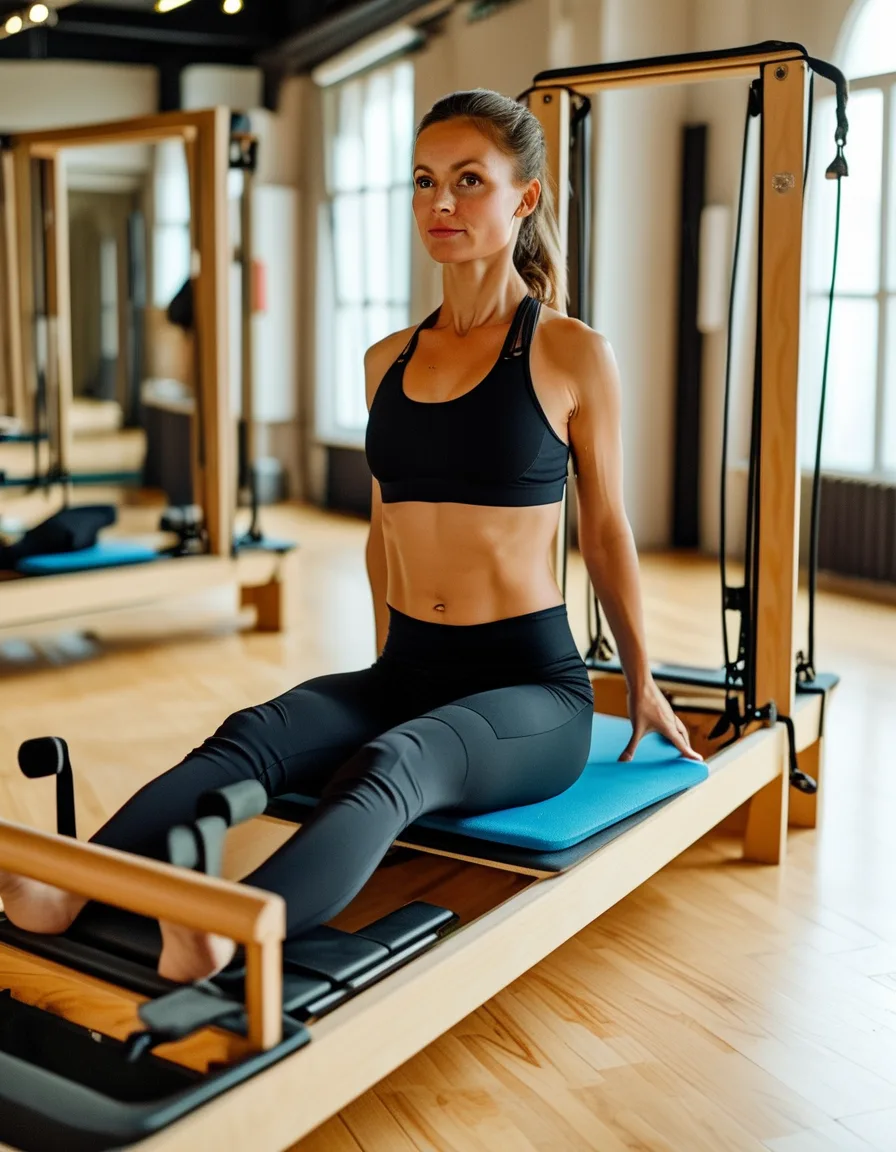
The springs create a physical boundary. On the mat, nothing stops a hypermobile knee or elbow from sliding into hyperextension except your own attention. On the reformer, spring tension is pushing back the whole time. The joint runs into resistance before it runs out of range.
You get constant feedback. Hypermobile joints have measurably poorer proprioception — the internal sense of where a limb is. Spring tension supplies that information from the outside. You can feel the load change as position changes, which is information a mat gives you exactly none of.
The return phase becomes real work. The carriage doesn’t just fall back. You control it against the springs, which means every rep contains a loaded eccentric. Eccentric strength through the mid-range is precisely what hypermobile joints tend to lack, and it’s the thing that makes a joint feel stable rather than merely flexible.
How should I set the springs if I’m hypermobile?
Heavier than you’d expect. This is the single adjustment that changes the most.
The instinct in a class is to lighten the springs so the movement feels bigger and smoother. For a hypermobile body, that’s backwards — lighter springs let the joint travel further, which is the opposite of the goal.
- Go one spring heavier than the exercise normally calls for. If footwork is usually taught on two red springs, try three. You’re using the spring as a brake, not a challenge.
- Work the middle of your range. Stop the movement before the end point. A hypermobile joint is least stable exactly where it’s most impressive-looking.
- Skip the maximum-stretch positions. Long stretch series, deep lunges on the carriage, anything sold as “opening up” — you don’t need more range. You need control of the range you already have.

What exercises need modifying?
Three come up constantly.
Footwork. Watch the knees. A hypermobile knee will snap into hyperextension at the end of every press, 30 times per set, which is a lot of reps of a pattern you don’t want. Stop about 10 degrees short of straight and hold there. It’ll feel like you’re cheating. You’re not.
Shoulder bridge and bridging variations. Lift the hips to a straight line from knee to shoulder and no further. Hypermobile lower backs will happily arch past that and call it a bigger bridge. The glutes should be doing the work; if you feel it in the low back, you’ve gone too high.
Arm series. Enough spring tension that your elbows can’t lock out at the end of the pull. If the arms feel weightless at the finish, the spring is too light.
What Nobody Tells You
Hypermobile people are often the “good” students in a Pilates class. You get into the shapes easily, your range looks enviable, and instructors praise it. That praise is actively unhelpful — the shapes you find easy are the ones giving you the least benefit.
The second thing nobody says: you usually can’t see your own compensation. Hyperextension feels like straight. Locking out feels like finishing the rep. Filming a single session on your phone every few weeks and watching the joints — not the overall shape — is more useful than any cue, because it shows you something your proprioception genuinely can’t report.
And the third: progress for a hypermobile body looks like smaller movement over time, done with more control and more load. If your range is shrinking and your stability is climbing, that’s the win, even though it photographs worse.
Telling your instructor
Say it before the first session, not after something hurts. “I’m hypermobile, I’d like heavier springs and I’m working on control rather than range” is enough — a good instructor will adjust spring settings and cues from there, and it saves you 45 minutes of being encouraged into positions you should be avoiding.
When to see a professional: if you have a hypermobility diagnosis such as hEDS or HSD, or you get frequent joint subluxations, dislocations, or pain that lasts more than a day or two after class, work with a physical therapist who knows connective tissue disorders before adding reformer sessions. This is general guidance, not a treatment plan, and hypermobility varies a lot from person to person.
FAQ
Is reformer Pilates safe for hypermobile joints?
Generally yes, and often better tolerated than mat work, because the springs limit how far a joint travels. The safety depends on setup — heavier springs, mid-range focus, no end-range stretching. Unmodified reformer programming can push a hypermobile joint just as far as mat work does.
Should hypermobile people stretch at all?
Rarely, and not passively. Most hypermobile bodies already have more range than they can control, so more stretching adds to the problem. Strength through the range you have is the priority; if something feels tight, it’s often a muscle guarding an unstable joint rather than a genuinely short muscle.
How many reformer sessions a week for hypermobility?
Two sessions a week is a reasonable starting point, with at least one rest day between. Joint control builds slowly, and hypermobile bodies often feel fine during a session and sore or unstable a day later — so add frequency only after a few weeks of no next-day flare.
TL;DR:
- Springs give hypermobile joints an external boundary and constant position feedback that mat work can’t provide.
- Set springs heavier than standard — you’re using them as a brake, not a challenge.
- Work mid-range, stop about 10 degrees short of lockout, skip maximum-stretch exercises.
- Watch knees in footwork, hip height in bridging, elbows in the arm series.
- Film yourself occasionally; hyperextension feels straight from the inside.
- Tell your instructor up front, and see a PT first if you have a diagnosis or frequent subluxations.
Keep Reading
This article is for general informational purposes only and is not medical advice. Always consult a qualified health professional for guidance specific to you.