Why Shoe Fit Is Harder to Judge With Hypermobile Feet (and What to Check Instead)
Quick Answer: Hypermobile feet can flatten and shift more under load than a standing store try-on reveals, so checking fit after walking around for several minutes, and prioritizing structured arch support and a firm heel counter over flexibility, gives a more accurate read than the usual quick fit test.
The shoe felt perfectly fine standing at the shelf, and by the second hour of wearing it, the arch has collapsed further than expected — a common and specific problem for hypermobile feet that a quick try-on doesn’t reveal.

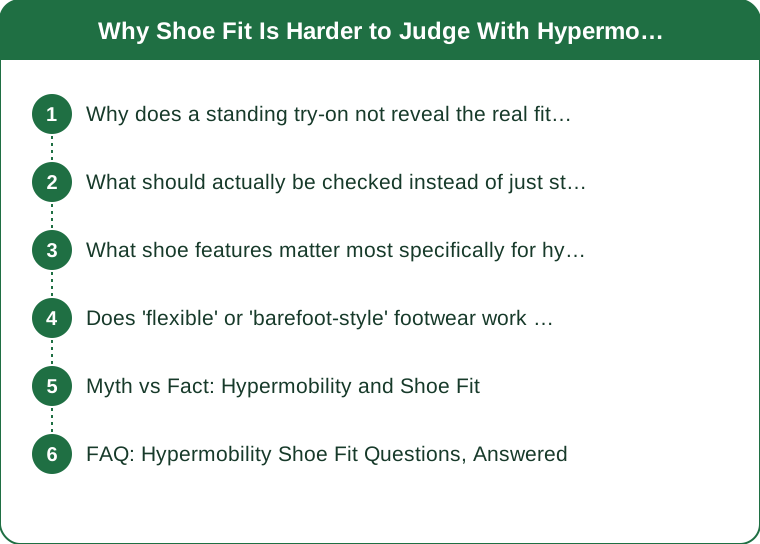
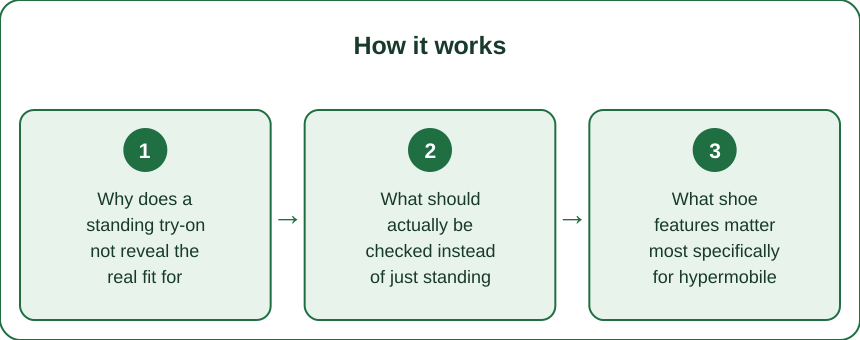
Why does a standing try-on not reveal the real fit for hypermobile feet?
Hypermobile joints, including those in the foot and ankle, can shift and flatten more under sustained load and movement than they do standing still for a brief moment — a shoe that looks supportive at a standstill may not actually hold that support once walking and weight-shifting begin in earnest.
What should actually be checked instead of just standing in the shoe?
Walking around the store for several minutes, not just a few steps, gives a more accurate sense of how the shoe behaves once the foot naturally shifts and flattens somewhat under repeated load — this reveals arch collapse or heel slip that a brief standing check misses.
What shoe features matter most specifically for hypermobile feet?
- A firm, structured heel counter that resists collapsing inward, since ankle hypermobility can make heel stability especially important
- Real arch support, not just a cushioned insole, since a soft insole alone doesn’t prevent excess arch flattening
- A wider, more stable base rather than a narrow or minimalist sole, which offers less resistance to excess joint movement

Does ‘flexible’ or ‘barefoot-style’ footwear work well for hypermobile feet?
Not usually as a default choice — highly flexible, minimal-structure shoes are often marketed as allowing natural foot movement, but for hypermobile feet that movement can already be excessive, meaning more structure, not less, is often the more comfortable and stable choice.
Myth vs Fact: Hypermobility and Shoe Fit
Myth: If a shoe fits well standing in the store, it will fit well all day. Fact: Hypermobile feet can shift and flatten more under sustained load than a brief standing check reveals.
Myth: Flexible, minimalist shoes are always the more ‘natural’ and comfortable choice. Fact: For hypermobile feet, more structure and arch support often provides more comfort and stability than minimal, flexible designs.
Myth: Shoe size is the main fit factor to get right. Fact: Structural features like heel counter firmness and arch support often matter more than size alone for this specific foot type.
FAQ: Hypermobility Shoe Fit Questions, Answered
How long should I walk around before trusting a shoe’s fit?
At least 5-10 minutes of continuous walking gives a more realistic sense of how the shoe holds up than a few steps at the shelf.
Are custom orthotics worth considering for hypermobile feet?
They can help significantly for some people by adding targeted arch support a standard insole doesn’t provide, though a podiatrist’s input is useful for a personalized recommendation.
Should hypermobile feet avoid all minimalist or barefoot-style shoes?
Not necessarily for very short, controlled use, but as an everyday default, more structured support is generally the safer and more comfortable choice for this foot type.
TL;DR:
- A standing try-on doesn’t reveal how hypermobile feet behave under sustained load
- Walking several minutes in-store gives a more accurate fit read
- A firm heel counter and real arch support matter more than flexibility
- Minimalist, highly flexible shoes often aren’t the best everyday default here
This is general information, not medical advice — a podiatrist can help with persistent foot pain or fit issues.
Keep Reading
This article is for general informational purposes only and is not medical advice. Always consult a qualified health professional for guidance specific to you.