Hypermobility and Sitting Cross-Legged: Why the Easiest Position Costs You
Quick Answer: Cross-legged sitting feels easy with hypermobility because you are hanging on ligaments instead of using muscle. Passive end-range positions cost nothing in the moment and produce deep hip ache, stiff hamstrings, and a wobbly first ten minutes of walking later the same day. The fix is not to stop sitting on the floor - it is to sit higher (a 3 to 5 inch cushion), change position every 15 to 20 minutes, and add 90 seconds of active hip work before you stand up.
Most hypermobile people discover this backwards: they assume the position is fine because it never hurt while they were in it.

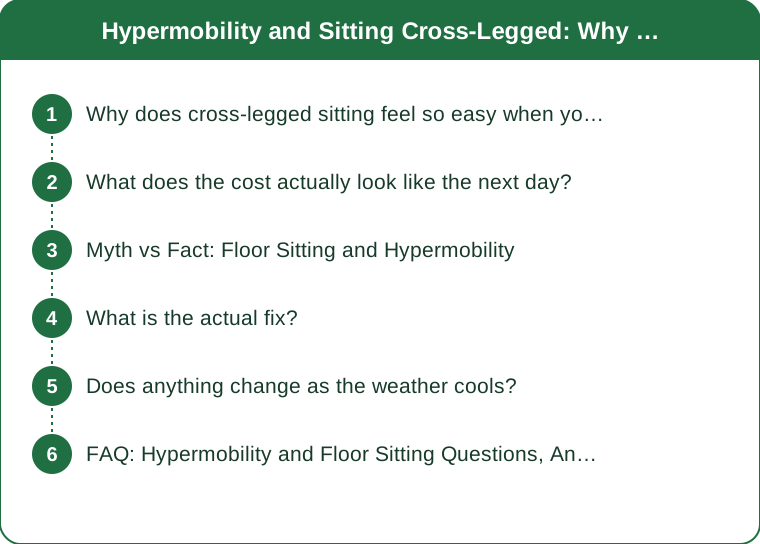
Why does cross-legged sitting feel so easy when you are hypermobile?
Because your joints let you park at end range, and parking costs nothing.
In a typical hip, external rotation runs out well before the knee reaches the floor, so cross-legged sitting requires ongoing muscular effort to hold. With hypermobility, the joint capsule and ligaments allow more range than the surrounding muscle actively controls, so you drop into the bottom of that range and let the connective tissue hold you there.
That is a genuinely restful sensation. It is also a load on passive tissue rather than active tissue, and passive tissue does not send the same fatigue signals muscle does. There is no burn to tell you to shift.
Ten to fifteen minutes is roughly where the cost starts for most people, and the bill arrives two to six hours later as a deep ache in the front or outside of the hip.
The second-order problem is trust. Sitting in end range for years teaches your nervous system that the bottom of your range is a safe resting place, which reduces the protective muscle tone you want when you are carrying groceries or catching yourself on a curb.
What does the cost actually look like the next day?
It shows up in four fairly predictable ways.
A slow, wobbly first ten minutes. Standing up after a long floor session and feeling like your hips need to find themselves again is a control problem, not a stiffness problem.
Deep hip ache without a specific injury moment. Hypermobile joints held at end range irritate the capsule, and capsular irritation is diffuse - people describe it as inside the joint and hard to point at.
Hamstrings that feel tight but do not respond to stretching. They are working overtime as brakes, and stretching a muscle that is guarding usually makes the next day worse.
One side worse than the other. Almost everyone has a habitual cross - same leg in front every time. That asymmetry compounds over months and is one of the most common drivers of one-sided hip pain in hypermobile people who otherwise train sensibly.
Myth vs Fact: Floor Sitting and Hypermobility
Myth: If it does not hurt while you are doing it, it is fine. Fact: Passive end-range loading is the one thing hypermobile bodies are least able to feel. Absence of pain in the moment is not feedback - the delayed ache is the feedback.
Myth: You should avoid the floor entirely. Fact: Floor sitting has real value - it keeps hips mobile, it is how you play with kids and pets, and avoiding it shrinks your usable range. The variable to change is height and duration, not the activity.
Myth: Your hips are too tight, which is why you slump. Fact: Hypermobile people slump into cross-legged sitting because of too much available range and too little active control. Stretching more usually makes the slump easier to reach and harder to hold.
Myth: A firmer surface fixes it. Fact: Surface firmness barely matters. Hip height relative to knee height is what changes the load, which is why a cushion works and a hard floor with no cushion does not.
Myth: If you are strong, you can sit however you like. Fact: Strength helps enormously but does not override a 90-minute passive hold. Even strong hypermobile people need to change position; they just recover faster when they forget.

What is the actual fix?
Four changes, none of which require giving up the floor.
1. Get your hips above your knees. Sit on a 3 to 5 inch cushion, folded blanket, or yoga block. This single change takes the hip out of end range and lets muscle share the work. If your knees are still above your hips, go higher.
2. Set a 15 to 20 minute limit per position. A timer sounds fussy for the first week and then becomes automatic. Alternate which leg is in front every single time - this is where the asymmetry gets fixed.
3. Rotate through positions rather than defending one. Cross-legged, one leg extended, kneeling with a cushion between heels and hips, side-sitting, then back. Five positions rotated through an evening is far better than the best single position held for two hours.
4. Add 90 seconds of active work before standing. Sit tall, press both knees gently down into the floor for 5 seconds, 8 times, then lift each knee an inch off the floor and hold for 5 seconds, 5 times per side. This wakes up the exact muscles that switched off, and it is the difference between standing up wobbly and standing up ready.
And build the capacity separately. Two or three times a week, 90/90 hip switches (8 slow reps per side) and isometric hip external rotation holds against a band (5 sets of 20 seconds) give you active control over the range you already own. Hypermobile hips do not need more range; they need to be strong in the range they have.
Does anything change as the weather cools?
Yes, and the timing is now.
Cooler rooms mean longer floor sessions. Late summer evenings on the balcony become autumn evenings on the living room floor, and total floor time quietly doubles between August and October.
Cold joints feel less, not more. Hypermobile people commonly report reduced position sense in cold conditions, which means the feedback that would have told you to shift is even quieter than usual. A blanket over the legs is not just comfort - it is proprioceptive input.
Softer, thicker clothing changes what you notice. Loose sweatpants remove the light skin tension that flexible leggings provide, and that tension is a genuine cue about where your joints are. Plenty of hypermobile people find fitted training leggings for floor evenings noticeably steadier, which sounds like a small thing and is not.
Movement snacks get skipped. In summer you get up for water, for the window, for a walk. In autumn you settle in. Adding one deliberate stand-up per episode of television covers most of it.
FAQ: Hypermobility and Floor Sitting Questions, Answered
Is sitting cross-legged bad for hypermobile hips?
Not inherently. Sitting cross-legged at end range for long stretches is what causes trouble. Raise your hips 3 to 5 inches, cap it at 15 to 20 minutes, and alternate your leading leg, and it stops being a problem for most people.
Why do my hips ache hours later rather than at the time?
Capsular and ligamentous irritation has a delayed onset, and passive tissue does not produce the burning fatigue signal muscle does. Several hours later is completely typical, and it is why the connection is so easy to miss.
Should I stretch my hips if they ache after floor sitting?
Usually not with long passive stretches, which add more end-range time to a joint that just had too much. Gentle active movement through mid-range - slow 90/90 switches, easy walking, glute bridges - tends to settle it faster.
Does W-sitting matter for hypermobile adults?
It is the same principle at a more extreme angle, so the same rules apply: raise the hips, cap the duration, and vary the position. If it is your automatic default, that is worth noticing.
This is general information, not medical advice. Persistent joint pain, instability, or subluxation is worth reviewing with a physiotherapist familiar with hypermobility.
TL;DR:
- Cross-legged sitting feels effortless with hypermobility because you are resting on ligaments rather than using muscle - and passive loading gives no in-the-moment warning.
- The bill arrives hours later as deep hip ache, guarding hamstrings, and a wobbly first ten minutes.
- Fix it with a 3 to 5 inch cushion, a 15 to 20 minute cap, alternating your leading leg, and 90 seconds of active hip work before standing.
- As evenings move indoors, total floor time rises and joint feedback drops - a blanket, fitted layers, and one deliberate stand-up per episode cover most of it.
The useful reframe is that hypermobility does not need less floor time, it needs better-supported floor time. Raising your hips a few inches is a small physical change that moves the load from tissue that cannot complain to tissue that can - and tissue that can complain is tissue that gets stronger.
See It in Motion
Seen here: High Waist Yoga Leggings with Side Pockets — shop it on bubblelime.com
Keep Reading
This article is for general informational purposes only and is not medical advice. Always consult a qualified health professional for guidance specific to you.