How to Set Up a Standing Desk When You Have Hypermobile Joints
Quick Answer: Hypermobile joints need a standing desk set up with a slight knee micro-bend, forearm support, and a scheduled sit-stand rotation — locking joints into a straight, passive stance for long periods is what causes most of the discomfort.
Standing desks get recommended as a fix for sitting too much. For hypermobile joints, an unadjusted one can trade one problem for another.

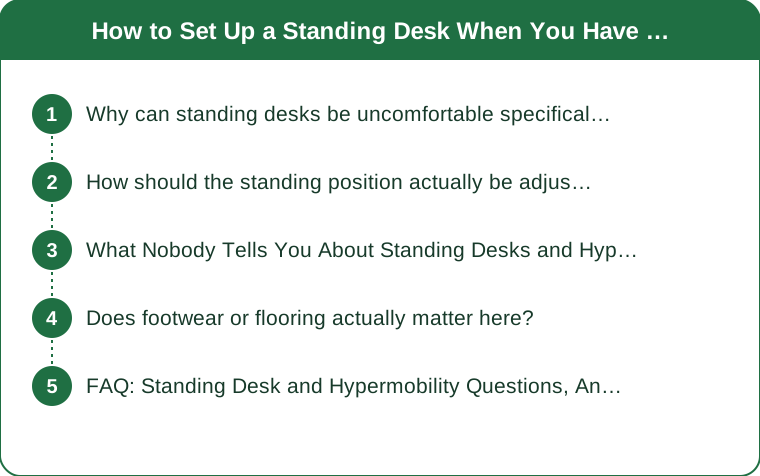
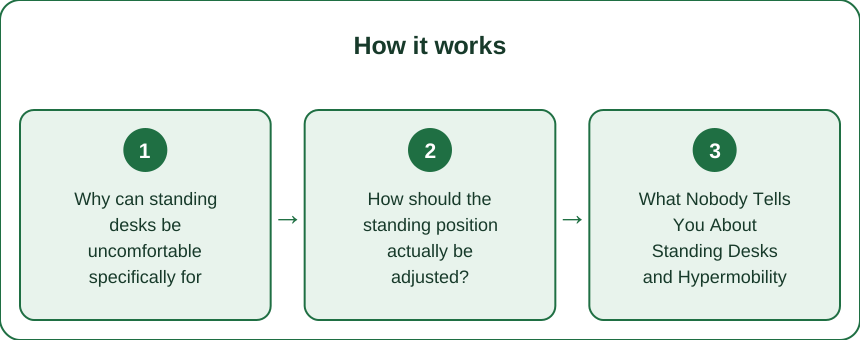
Why can standing desks be uncomfortable specifically for hypermobile joints?
Because hypermobile joints tend to rest into their end range when unsupported, meaning knees can hyperextend and hips can shift into a passive, locked stance without you noticing — that passive locking is what creates the ache, not standing itself.
Over a long stretch, that locked position puts sustained load on ligaments rather than muscles, which is exactly the opposite of what you want for joint stability.
How should the standing position actually be adjusted?
A deliberate, slight micro-bend in the knees — just enough that they’re not locked straight — keeps the load on supporting muscles instead of ligaments, which is the single biggest adjustment that helps hypermobile standing comfort.
A forearm-height desk with elbows at roughly 90 degrees, rather than reaching down or up, reduces the tendency for hypermobile shoulders and wrists to compensate into strained positions.

What Nobody Tells You About Standing Desks and Hypermobility
A timer-based rotation (20-30 minutes standing, then sitting) works better than “stand as much as you can” — hypermobile joints fatigue their stabilizing muscles faster than average, so pushing through discomfort tends to backfire within the same day.
Another overlooked detail: a supportive, cushioned mat under bare feet or thin-soled shoes reduces the tendency to shift weight into a hip or knee lock for relief, which quietly reinforces the pattern this setup is trying to avoid.
Does footwear or flooring actually matter here?
Yes — a firm, slightly cushioned surface gives your foot and ankle a stable base to activate stabilizing muscles, while a hard, unforgiving floor tends to encourage passive locking further up the chain as a shortcut to comfort.
Supportive shoes with some structure, rather than fully flat minimalist soles, give hypermobile ankles a bit more feedback and control during long standing periods.
FAQ: Standing Desk and Hypermobility Questions, Answered
How long should I stand at a time with hypermobile joints?
20-30 minutes at a time is a reasonable starting point, with a seated break before fatigue sets in, rather than pushing to an hour or more early on.
Is a standing desk still worth it if I have hypermobile knees?
Yes, with the adjustments above — the goal is alternating positions, not eliminating sitting entirely, so a well-set-up standing desk is still a useful tool.
Should I check with a physical therapist before changing my setup?
If you have a diagnosed hypermobility condition like EDS, a PT familiar with it can fine-tune this setup to your specific joints — this article is general information, not medical advice.
TL;DR:
- Passive joint-locking, not standing itself, causes most hypermobile standing desk discomfort
- A slight knee micro-bend and 90-degree elbow height are the two biggest fixes
- Timer-based sit-stand rotation beats pushing through fatigue
- Supportive footwear and flooring give joints better stabilizing feedback
Small setup changes usually matter more than the desk itself — start with the knee bend and elbow height before assuming standing desks just aren’t for you. This is general information, not medical advice.
Keep Reading
This article is for general informational purposes only and is not medical advice. Always consult a qualified health professional for guidance specific to you.