The Biggest Myth About Strength Training With Hypermobile Joints
Quick Answer: The common belief that hypermobile joints should avoid strength training has it backwards — building strength around a hypermobile joint is one of the main ways to improve its stability, since muscles compensate for what lax ligaments alone can’t control. The key is controlled, moderate-load training, not avoidance.
The instinct to protect a hypermobile joint by avoiding load entirely often makes instability worse over time, not better.

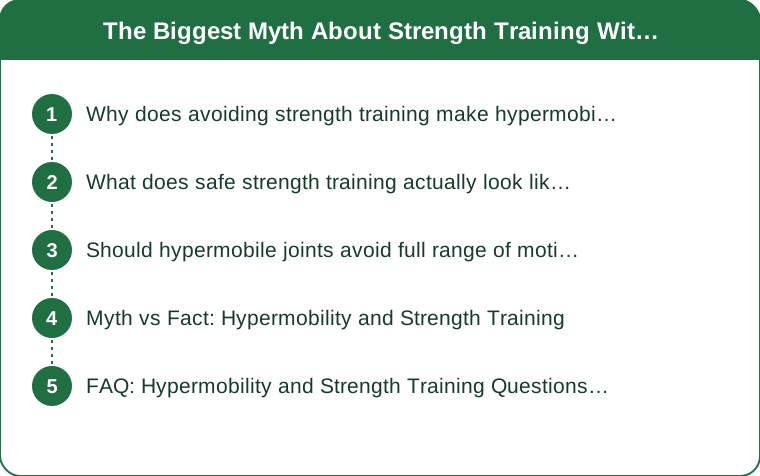
Why does avoiding strength training make hypermobile joints less stable, not more?
Joint stability comes from a combination of ligament tension and surrounding muscle support — hypermobile joints have naturally looser ligaments, meaning muscle strength has to do proportionally more of the stabilizing work. Avoiding strength training removes exactly the compensating mechanism that keeps a hypermobile joint controlled during movement.
What does safe strength training actually look like for hypermobile joints?
Controlled range of motion, moderate loads, and a focus on the muscles surrounding the joint — rather than training into the joint’s maximum available range, which is where instability risk is highest. Slower, controlled tempo also gives supporting muscles more opportunity to engage properly.

Should hypermobile joints avoid full range of motion entirely?
Not necessarily full avoidance, but training to a slightly more controlled range — stopping just short of the joint’s absolute end range — reduces the risk of relying on passive ligament tension rather than active muscular control during the movement.
Myth vs Fact: Hypermobility and Strength Training
Myth: Hypermobile joints should stick to stretching and avoid resistance training. Fact: Targeted strength training is one of the most evidence-supported ways to improve joint stability and reduce injury risk for hypermobile individuals. Myth: More flexibility work will help a hypermobile joint feel more stable. Fact: Additional stretching in an already lax joint can increase instability risk rather than reduce it — strength, not more range, is usually the missing piece.
FAQ: Hypermobility and Strength Training Questions, Answered
Should I work with a professional before starting strength training with hypermobile joints?
A physical therapist familiar with hypermobility can help identify which joints need the most stabilizing focus and design a program around your specific pattern, which is especially useful when starting out.
Is it normal for hypermobile joints to feel unstable even during strength training?
Some awareness of instability is common, especially early on, but sharp pain or a joint that feels like it’s giving way during a lift is a signal to reduce load or range and reassess, not push through.
How long does it typically take to notice improved stability from strength training?
Many people notice a meaningful difference in perceived joint stability within 6-8 weeks of consistent, controlled strength training, though this varies by individual and by which joint is involved.
TL;DR:
- Muscle strength compensates for what lax ligaments can’t stabilize alone
- Controlled range and moderate loads are safer than full end-range training
- More flexibility work often worsens instability rather than helping
- Noticeable stability improvements typically take 6-8 weeks of consistent training
Strength training, done with control rather than avoided out of caution, is one of the most useful tools for a hypermobile joint, not a risk to steer clear of.
Keep Reading
This article is for general informational purposes only and is not medical advice. Always consult a qualified health professional for guidance specific to you.