Yoga While Hypermobile: Practicing the Bendy Body Safely
Quick Answer: Yoga is safe and often excellent for hypermobile bodies — but only with three modifications: take every pose to about 80% of your available range instead of your end range, actively hold poses with muscular engagement rather than hanging on your ligaments (keep a micro-bend in every “straight” limb), and use props to stop yourself sooner rather than to reach further. Tell your teacher before class that you’re hypermobile and don’t want to be adjusted deeper.
Hypermobile people tend to be good at yoga immediately, in the sense that the shapes arrive without effort. Full forward fold on day one. Hands flat on the floor. Teachers say encouraging things.
That’s the problem. The pose was never the point, and a bendy body gets handed the pose for free while skipping everything the pose was supposed to build.

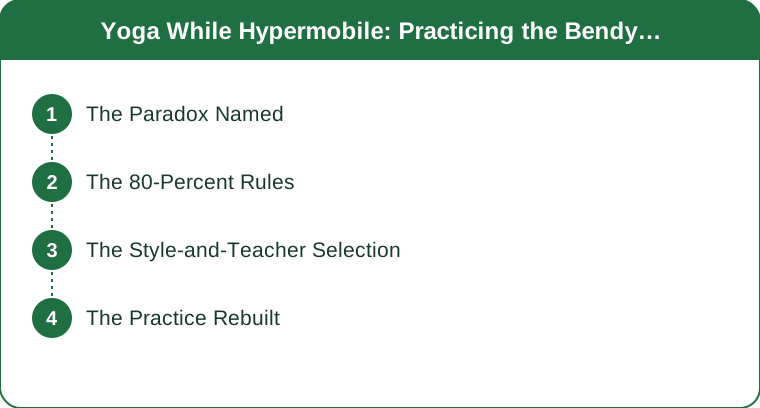
The hypermobile yoga paradox
You get false mastery. The deep pose arrives via joint laxity, not earned range. The flexibility was never the goal; the strength and control that were supposed to develop alongside it simply don’t.
End-range hanging is the actual risk. A deep pose held passively means you’re resting on ligaments and joint capsules rather than supporting yourself with muscle. Do that weekly for years and you’re training your joints to be looser, in a body that already has more range than it can control.
The praise reinforces it. A teacher complimenting your depth, or physically adjusting you further into a pose, is doing exactly the wrong thing for you specifically — even though it’s usually a kind instinct.
And yet: yoga’s real gifts map remarkably well onto what hypermobile bodies need. Body awareness (proprioception is often reduced in hypermobility). Strength through range. Breathwork and nervous-system regulation. None of those require depth. All of them get skipped by a depth-chasing practice.
Realign the practice and it serves you better than almost anything else.
The 80% rules
1. Take poses to 80% of your available range. Your “edge” is past where it’s safe, so the buffer is the practice. If a forward fold could go to your shins, go to your knees. This will feel like you’re doing less. You’re doing more.
2. Hold, never hang. Every pose actively engaged. If your body is being supported by the structure of your joints rather than by muscle, you’re hanging. The test: could you lift out of this pose an inch under your own power right now? If not, engage.
3. Micro-bend every straight limb. Elbows in downward dog and plank. Knees in triangle, forward folds, and standing poses. Hypermobile joints hyperextend past neutral — locking out means the joint takes load the muscle should. The micro-bend is non-negotiable and it’s the single most protective habit on this list.
4. Use props as boundaries, not extensions. This inverts the usual prop philosophy. A block under your hand in triangle isn’t there to help you reach the floor — it’s there to stop you from reaching the floor. Same object, opposite job.
5. Take deep backbends and extreme hip poses conservatively or skip them. Wheel, deep pigeon, splits, lotus. These are the party-trick poses that hypermobile bodies find easy and pay for slowly.
6. Change the internal question. From “how deep can I go?” to “how supported am I?” That reframe replaces the entire grading rubric of your practice, and it’s the thing that makes the other five rules stick.

What nobody tells you about practicing bendy
Engagement feels like nothing at first. Hypermobile people often have reduced proprioception — you genuinely can’t feel where your joints are as precisely as other people can. So “engage your quad” produces confusion rather than sensation. It comes with practice, and slow transitions are where it develops.
The muscle burn is the novel sensation. Most yogis chase the stretch. For you, the useful, unfamiliar feeling is work — chair pose burning, plank shaking. If a class leaves you feeling stretched but never worked, it wasn’t the right class.
Backing off in a class full of people going deeper is socially hard. Nobody warns you about this. You’ll be the person in a modified triangle while everyone folds in half. It gets easier once you decide the room isn’t grading you.
Hypermobility often comes with fatigue, and yoga can flare it. If you’re managing a hypermobility spectrum disorder or hEDS, gentle strength-focused sessions are often better tolerated than long dynamic flows. Pacing matters more than intensity.
Your “good” days are the dangerous ones. On a day when everything feels loose and easy, that’s when the end-range injuries happen. The 80% rule matters most exactly when it feels least necessary.
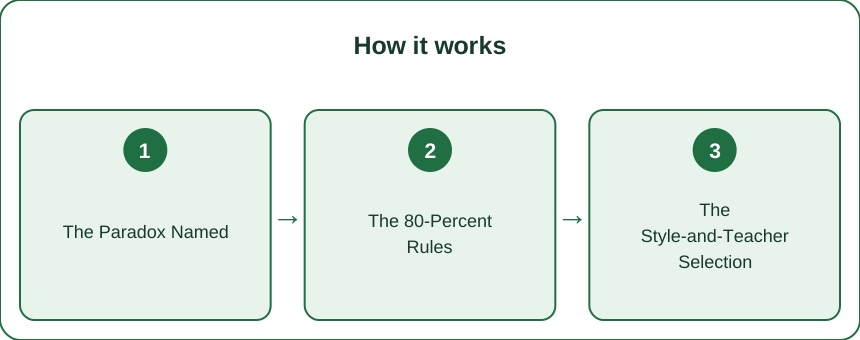
Choosing the right class and teacher
Styles that tend to serve bendy bodies: alignment-focused practices (Iyengar and Iyengar-adjacent, with their heavy prop use and precision cueing), strength-forward vinyasa, and yoga-sculpt style classes that add load.
Styles to approach carefully: deep-stretch and “extreme flexibility” classes, hot yoga (heat plus laxity is a bad combination for end range), and any class marketed on how deep you’ll get. Yin can work well, but only with the 80% rule and props used as boundaries — the long passive holds are otherwise exactly the wrong stimulus.
Have the conversation before class. One sentence: “I’m hypermobile — please don’t adjust me deeper into poses.” Good teachers hear this gratefully; it makes their job easier. A teacher who ignores it is telling you something useful about the room.
Signs of a good teacher for you: cues engagement rather than depth, says “back off ten percent” out loud, celebrates control over contortion, and asks about consent before hands-on adjustments.
Practicing at home: you have to self-enforce the 80% rule with no external eye. Practice in front of a mirror or film a session occasionally — hypermobile people are consistently surprised by how hyperextended their elbows and knees look on video compared to how they feel.
When to see a professional
Talk to a physiotherapist — ideally one experienced with hypermobility — before starting or continuing a practice if you have frequent joint subluxations or dislocations, ongoing joint pain, or a diagnosed hypermobility spectrum disorder or hypermobile Ehlers-Danlos syndrome. Stop and get assessed for a joint that gives way, sharp joint pain during a pose, or numbness and tingling. A physio can also build the targeted strength work that makes yoga safer for you specifically.
FAQ
Is yoga good for hypermobility?
It can be very good, provided you practice for strength and control rather than depth. The body-awareness training, the strength through range, and the nervous-system work are all valuable. A depth-chasing practice, on the other hand, tends to make hypermobility-related problems worse over time.
Should hypermobile people avoid stretching?
Not entirely, but passive end-range stretching gives you very little — you already have the range — and adds risk. What hypermobile bodies benefit from is strengthening through the range they already have, plus gentle mobility work that stays inside the 80% boundary.
What yoga poses should hypermobile people avoid?
Approach deep backbends (full wheel), splits, lotus, deep pigeon, and any pose that relies on hanging in end range with care — modify them, cut the depth substantially, or skip them. Also avoid locking out elbows and knees in any pose, which means adding a micro-bend to plank, downward dog, triangle, and standing poses.
TL;DR:
- Take every pose to about 80% of your available range — the buffer is the practice.
- Hold poses actively; never hang on ligaments. Micro-bend every “straight” limb.
- Props are boundaries, not extensions — a block that stops you, not one that helps you reach.
- Approach deep backbends, splits, and extreme hip poses conservatively or skip them.
- Change the question from “how deep?” to “how supported?”
- Choose alignment-focused or strength-forward classes; be cautious with deep-stretch and hot yoga.
- Tell the teacher before class: hypermobile, please don’t adjust me deeper.
- Frequent subluxations, joint pain, or diagnosed hEDS means see a physio first.
Keep Reading
This article is for general informational purposes only and is not medical advice. Always consult a qualified health professional for guidance specific to you.