Why Autumn Weather Swings Affect Hypermobile Joints More Than Steady Cold
Quick Answer: Hypermobile joints tend to struggle more in variable weather than in consistently cold weather, and the likely reasons are practical rather than mysterious. Rapid swings disrupt the routines that keep hypermobile bodies stable - activity levels, sleep, hydration and warm-up all become inconsistent. Cold reduces tissue elasticity and proprioceptive accuracy, both of which hypermobile people rely on more than average. And barometric pressure changes are associated with increased joint pain reporting, though the evidence is mixed and the effect size is modest. The practical response is to make your routine less weather-dependent, not to chase the forecast.
A steady cold week in January is manageable. Three weeks of autumn where it is 70F on Monday and 45F on Thursday is when everything aches.
That pattern is common enough among hypermobile people to be worth explaining properly.

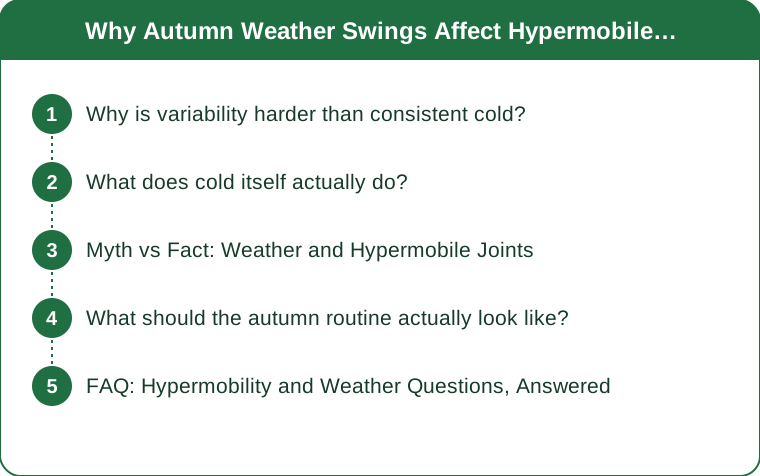
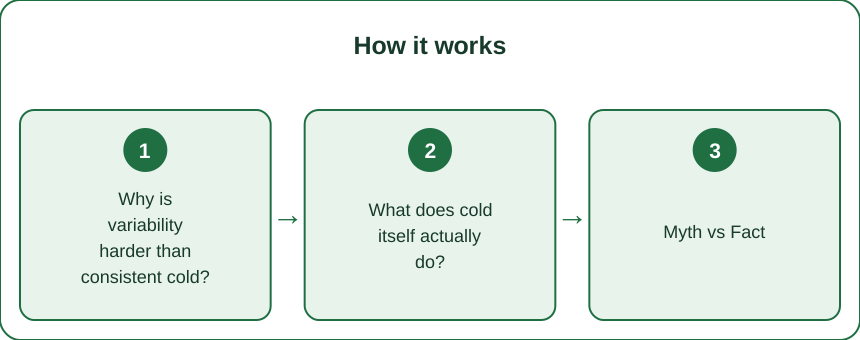
Why is variability harder than consistent cold?
Because hypermobile stability is largely built from routine, and variable weather breaks routine.
Hypermobile joints depend more heavily on active muscular control than on passive ligament restraint. That active control is trainable, but it is also state-dependent - it degrades with fatigue, with cold, with poor sleep and with inconsistent loading.
Consistent conditions let you build a consistent routine. You know how long your warm-up needs to be, what you will wear, when you will walk, and how much your joints will tolerate.
Variable conditions destroy that. A warm day produces more activity than planned; a cold day produces less. The pattern of one high-activity day followed by a low-activity day is precisely the pattern that hypermobile people tend to tolerate worst, because deconditioning between bouts and overload within them both work against joint stability.
Sleep gets disrupted too. Autumn temperature swings, changing bedding and shifting daylight all fragment sleep, and poor sleep reliably amplifies pain sensitivity and reduces motor control in exactly the way hypermobile bodies can least afford.
And hydration typically drops as thirst falls in cooler weather, which matters for connective tissue and for the fatigue that so often accompanies hypermobility.
So the honest explanation is mostly indirect. The weather is not attacking your joints. It is disrupting four things that were holding them together.
This is general information, not medical advice.
What does cold itself actually do?
It stiffens tissue and degrades the position sense that hypermobile people rely on.
Muscle and connective tissue viscosity increases as temperature falls. Cold tissue is stiffer, contracts slightly more slowly, and reaches its comfortable range of motion later. For most people that means a longer warm-up. For hypermobile people it means something more specific: the muscular control that substitutes for ligamentous restraint is slower to engage.
Proprioception is the bigger issue. Position sense is already measurably reduced in many hypermobile people, and cold reduces proprioceptive acuity further by slowing peripheral nerve conduction and reducing skin and joint receptor sensitivity.
The practical result is more end-range mistakes - joints going further than intended without you noticing - which is the mechanism behind a lot of hypermobility flare-ups.
Peripheral vasoconstriction adds to it. Reduced blood flow to hands and feet means cold, stiff fingers, which for anyone with hypermobile hands means grip fatigue arriving faster and more small-joint strain from compensating.
The practical implications are concrete. Longer warm-ups in cool weather, warmth at the extremities specifically, and more conservative end-range work in the first part of any session - not because you are more fragile, but because your feedback system is temporarily less accurate.
Gloves and warm layers are a proprioceptive intervention, not just a comfort one.

Myth vs Fact: Weather and Hypermobile Joints
Myth: Barometric pressure is the main cause of weather-related joint pain. Fact: It is associated with pain reports in several studies, but the evidence is mixed and effect sizes are generally small. Large studies have found modest or inconsistent relationships. It is likely real and likely minor compared with the behavioral and thermal factors.
Myth: Cold weather damages joints. Fact: There is no evidence that cold causes structural damage. What it does is change symptoms and control, which matters, but it is a reversible functional effect rather than harm accumulating.
Myth: If it hurts, you should rest until the weather settles. Fact: Extended rest is one of the worst strategies for hypermobility, because muscular control deconditions quickly and the joints have less passive restraint to fall back on. Reduce load and range, keep frequency. That is nearly always better than stopping.
Myth: Stretching will help the stiffness. Fact: For hypermobile people, the stiffness is usually protective muscular guarding, not short tissue. Stretching into it typically provides brief relief and worsens the underlying instability. Gentle movement through mid-range and isometric work address it far better.
Myth: Warm weather is always better. Fact: Many hypermobile people report worse fatigue and more autonomic symptoms in heat, particularly those with co-occurring orthostatic intolerance. The comfortable middle is often narrower than for other people in both directions.
What should the autumn routine actually look like?
Make the routine weather-independent, extend the warm-up, and keep frequency steady even when volume drops.
Move the anchor indoors. If your baseline movement is a daily outdoor walk, autumn will disrupt it repeatedly. Having an indoor equivalent that requires no decision - ten minutes of mobility and isometric work on a mat - keeps the frequency intact regardless of conditions.
Lengthen the warm-up rather than reducing the session. Cool tissue needs more time; the standard advice for hypermobile training already emphasizes thorough preparation, and autumn is when that becomes non-negotiable. Ten to fifteen minutes before anything demanding.
Prioritize isometrics in cooler conditions. Isometric holds build joint stability with minimal range of motion, which means less exposure to end range at exactly the time when your position sense is least reliable.
Keep the extremities warm specifically. Gloves, warm socks, long sleeves. This is the highest-return single change because it addresses both the grip fatigue and the proprioceptive degradation directly.
Avoid the boom-and-bust pattern. On the warm days, resist doing three times your normal volume. Pacing is the central skill in hypermobility management, and autumn weather is a persistent invitation to abandon it.
Keep hydrating. Thirst drops, losses do not, and fatigue is one of the first things that worsens.
And track it. A simple log of weather, activity, sleep and symptoms across six weeks will tell you which of these factors actually drives your pattern - and for most people the answer is sleep and activity variability rather than the temperature itself.
This is general information, not medical advice. New joint instability, subluxations, significant swelling or neurological symptoms should be assessed by a clinician rather than managed with routine changes.
FAQ: Hypermobility and Weather Questions, Answered
Is it real, or am I imagining the weather connection?
It is real in the sense that your symptoms genuinely change - the uncertainty in the research is about which mechanism dominates, not about whether people experience it. Studies on barometric pressure and joint pain are genuinely mixed, but the cold-related effects on tissue stiffness and proprioception are well established, and the behavioral effects on routine are obvious once you look for them.
Should I take extra measures before a forecast cold snap?
A settled cold snap is usually the easier scenario - you can plan for it. Add warmth, extend the warm-up, and keep your routine. The harder scenario to prepare for is the swinging week, where the useful preparation is having an indoor default that runs regardless of conditions.
Do compression garments help in cold weather?
Many hypermobile people find they do, and there is a plausible mechanism - compression provides additional sensory feedback about joint position, which partly compensates for reduced proprioception. The evidence base is limited but the risk is low. Autumn is a reasonable time to try, since the cold is degrading exactly the sense that compression supplements.
Why do I feel worse after a day of doing nothing on a cold day?
Because muscular stability degrades quickly with inactivity, and hypermobile joints have less passive restraint to fall back on. Static positions also load joints at end range for long periods - sitting collapsed on a sofa is a sustained end-range position for a hypermobile spine and hips. Frequent short movement beats one long session, particularly on low-activity days.
TL;DR:
- Variable weather is harder than settled cold because it breaks the routine that hypermobile stability depends on.
- Cold stiffens tissue and degrades proprioception - and position sense is what hypermobile joints rely on most.
- Barometric pressure effects are real but modest; behavior and temperature matter more.
- Do not rest through it. Reduce load and range, keep frequency - deconditioning costs more than the flare.
- Warm extremities are a proprioceptive intervention, not just comfort.
- Extend warm-ups to ten to fifteen minutes and favor isometrics in cool conditions.
- Avoid boom-and-bust on warm days. Pacing is the whole skill.
This is general information, not medical advice. Track six weeks of sleep, activity and symptoms - the pattern is usually clearer than the forecast.
Keep Reading
This article is for general informational purposes only and is not medical advice. Always consult a qualified health professional for guidance specific to you.