Why Do Hypermobile Joints Feel Tighter Than Normal Joints, Not Looser?
Quick Answer: Hypermobile joints often feel tight because surrounding muscles chronically overwork to compensate for lax ligaments — that constant low-level guarding creates a sensation of stiffness even though the joint’s actual range of motion is above average, not below it.
You can bend further than most people, your joints move in ways that make others wince, and yet you spend your days feeling stiff and tight, not loose. That contradiction confuses a lot of hypermobile people — here’s the actual mechanism behind it.

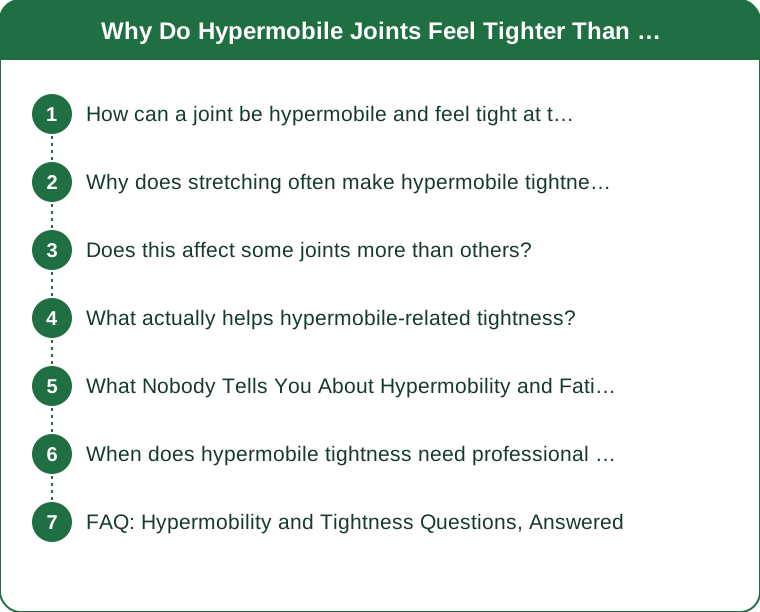
How can a joint be hypermobile and feel tight at the same time?
Ligaments provide passive joint stability — when they’re lax (the defining feature of hypermobility), your muscles have to work harder to provide the stability ligaments normally would, essentially staying in a low-level contracted state around the joint most of the time. That chronic muscular guarding is what registers as tightness or stiffness, even though the joint itself, if you tested its passive range of motion, moves further than average. You’re feeling muscle tension compensating for ligament laxity, not the joint’s actual limitation.
Why does stretching often make hypermobile tightness worse, not better?
This is the part that trips up a lot of hypermobile people, because ‘feels tight’ usually means ‘stretch it’ for most bodies. But stretching a joint that’s already hypermobile pushes further into a range the ligaments can’t stabilize, which often triggers more protective muscle guarding afterward, not less — the tightness can temporarily ease during the stretch and then return worse within hours as your nervous system responds to the added instability. Strengthening the muscles around the joint, not stretching them, is generally the more effective approach for hypermobile tightness.
Does this affect some joints more than others?
Yes — joints that rely more heavily on ligamentous stability in the general population (shoulders, ankles, and the lower back/SI joint area) tend to show this compensatory tightness pattern more noticeably in hypermobile individuals, because those are exactly the joints where muscles have the most stabilizing work to make up for. Fingers and wrists, while often visibly hypermobile, don’t carry the same load-bearing demand and so don’t always show the same tightness pattern.

What actually helps hypermobile-related tightness?
Targeted strength training around the affected joint — building the muscular stability that the ligaments aren’t providing reduces how hard those muscles have to guard, which in turn reduces the chronic tension reading as tightness. This is a slower fix than a stretch (which gives immediate but temporary relief), but it addresses the actual mechanism rather than the symptom. Working with a physical therapist familiar with hypermobility is genuinely valuable here, since generic strength programs don’t always account for the joint protection hypermobile training needs.
What Nobody Tells You About Hypermobility and Fatigue
The constant low-level muscular guarding hypermobile joints require isn’t free — it’s genuine extra energy expenditure happening all day, every day, which is part of why many hypermobile people report disproportionate fatigue compared to their actual activity level. This isn’t laziness or deconditioning; it’s muscles doing double duty as both movers and stabilizers, all day, for joints that don’t get passive support from lax ligaments the way average joints do.
When does hypermobile tightness need professional attention rather than self-management?
If tightness is accompanied by frequent joint subluxations or dislocations, significant pain that limits daily activity, or if you suspect a hypermobility spectrum disorder (like hEDS) rather than isolated joint laxity, that’s worth evaluation by a doctor or physical therapist specializing in hypermobility. Self-directed strengthening helps a lot of general hypermobile tightness, but it’s not a substitute for professional guidance when symptoms are significant. This is general information, not medical advice.
FAQ: Hypermobility and Tightness Questions, Answered
Should hypermobile people stretch less than average?
Generally, yes — excessive stretching of already-lax joints tends to increase compensatory muscle guarding rather than relieve it. Gentle, controlled range-of-motion work is usually better tolerated than deep static stretching.
Why do I feel exhausted even on low-activity days if I’m hypermobile?
The constant background muscular stabilization your joints need happens regardless of activity level, and that baseline energy cost is a documented factor in hypermobility-related fatigue.
Is strength training safe for hypermobile joints?
Yes, and it’s generally the recommended primary intervention — but working within a controlled, joint-protective range (avoiding end-range loading) matters more for hypermobile joints than for average ones. A physical therapist familiar with hypermobility can help build an appropriate program.
TL;DR:
- Tightness in hypermobile joints is usually muscle guarding compensating for lax ligaments, not the joint itself being limited
- Stretching often worsens this tightness by pushing further into unstable range
- Targeted strength training addresses the actual mechanism better than stretching does
- The constant background muscle work also explains disproportionate fatigue many hypermobile people report
The tightness is real, but it’s your muscles doing extra stabilizing work, not a sign your joints need more range — this is general information, not medical advice.
Keep Reading
This article is for general informational purposes only and is not medical advice. Always consult a qualified health professional for guidance specific to you.