Why Hypermobile Joints Feel Worse After a Long Drive
Quick Answer: Long drives hurt hypermobile joints because a car seat holds you in one loaded position with no micro-movement, while your stabilising muscles work continuously against vibration. Break the drive every 45 minutes, add lumbar and thigh support, and do two minutes of loaded movement at every stop.
You get out of the car after three hours and your hips feel welded. Your lower back aches in a way it never does after a gym session. Your neck is furious.
Meanwhile the person you drove with stretches once and walks off fine.
This is not weakness and it is not in your head. Sitting still in a moving vehicle is a specific kind of demand, and hypermobile bodies pay more for it.

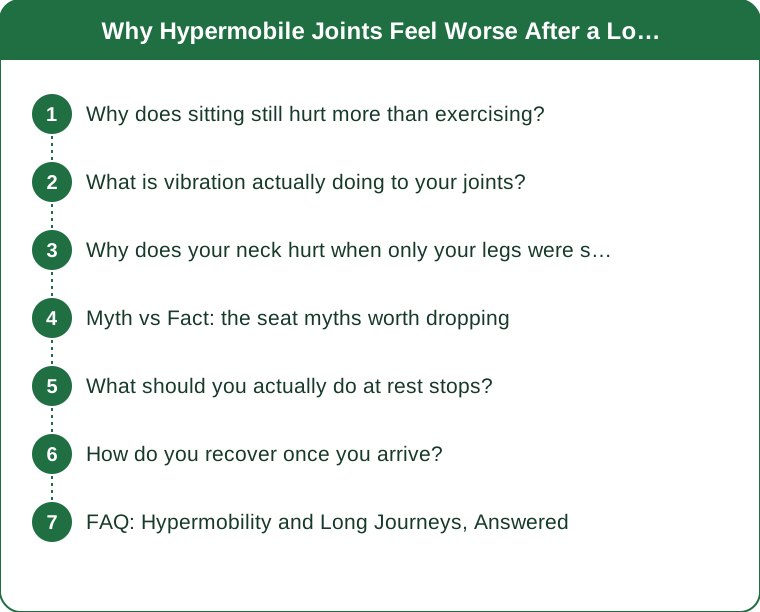
Why does sitting still hurt more than exercising?
Because movement is how connective tissue gets fed.
Cartilage and intervertebral discs have almost no direct blood supply. They exchange nutrients and waste through compression and decompression cycles — load on, load off, over and over. Movement is not optional maintenance for these tissues, it is their circulation.
When you sit motionless for two hours, that pump stops. Tissues sit under constant static load with no exchange. In a body with typical connective tissue this produces mild stiffness. In a hypermobile body, where tissues are already more compliant and rely more heavily on muscular support, the stiffness arrives faster and lands harder.
There is a second layer. Hypermobile joints depend on active muscular stabilisation rather than passive ligament tension. In a car you are holding a fixed position for hours, which means those stabilisers are doing a long, low-grade isometric hold with no rest. That is genuinely fatiguing work, and fatigued stabilisers is exactly the state that produces the deep ache you feel when you finally stand up.
What is vibration actually doing to your joints?
Road vibration is the part almost nobody accounts for.
A car transmits continuous low-frequency vibration through the seat into your pelvis and spine. Your postural muscles respond to every one of those tiny perturbations with a tiny correction. Over three hours that is thousands of small stabilising contractions you never consciously made.
For hypermobile people the correction load is higher, because there is less passive ligament stiffness damping the movement before muscle has to intervene. Your joints move further per bump, so your muscles work more per bump.
This is why the fatigue feels disproportionate to the activity. You did not exert yourself, but your deep stabilisers logged something closer to a long endurance set. It is also why the ache often peaks two to four hours after the drive rather than immediately, following the same delayed pattern as any other unaccustomed muscular work.
Why does your neck hurt when only your legs were still?
Because your head is heavy and your neck has been holding it against acceleration all day.
An adult head weighs roughly 4 to 5 kg. Every corner, brake and acceleration asks your neck to resist that mass moving in a direction you did not choose. Add a headrest positioned slightly too far back — which is most headrests — and you spend hours holding your head forward of neutral rather than resting it.
For hypermobile people the upper cervical region is often already a symptomatic area, and this is a straightforward explanation for why. The fix is dull but effective: bring the headrest forward until it lightly contacts the back of your head when you sit normally.
If your car’s headrest cannot come forward enough, a small rolled towel between the headrest and your skull does the same job. You want contact, not pressure.

Myth vs Fact: the seat myths worth dropping
Myth: A reclined seat is easier on your back. Fact: Reclining past about 110 degrees shifts your head forward relative to your torso, loading your neck for the entire drive. It also lets your pelvis slide into a rolled-back position that flattens the lumbar curve. Sit closer to upright than feels natural.
Myth: Lumbar support is a comfort feature. Fact: For hypermobile bodies it is a workload feature. Support in the small of your back means your spinal stabilisers do not have to hold that curve themselves for three hours. Rolled-up hoodie in a plastic bag works fine.
Myth: Cruise control is neutral. Fact: Cruise control removes ankle movement, which removes the calf pump that keeps blood moving in your lower legs. Alternating between cruise and manual throttle on a long straight is a genuine circulation strategy.
Myth: You should stretch hard at every stop. Fact: End-range stretching is the least useful thing a hypermobile person can do to a stiff joint. It buys twenty minutes and often costs stability. Load it instead — see below.
What should you actually do at rest stops?
Stop every 45 minutes, not every two hours, and make the stop about load rather than length.
The two minutes that work:
- Ten slow bodyweight squats to a comfortable depth. This restores the compression-decompression cycle through hips, knees and spine faster than anything passive.
- Ten calf raises off a kerb. Circulation, ankle mobility, and a reminder to your lower leg that it exists.
- Thirty seconds of a wall press — palms on the car roof or a wall, gently pushing — to wake the shoulder and scapular stabilisers that have been idle.
- A 90-second walk. Not a stroll to the toilets, an actual brisk walk with arm swing.
Skip the hamstring stretch on the bumper. It is the reflex move and it is the wrong one. Hypermobile hamstrings are rarely short; they feel tight because they are protectively toned around an unstable pelvis. Stretching them deepens the instability while temporarily masking the sensation.
Hydration matters more than it seems, too. People underdrink on drives specifically to avoid stops, which raises tissue stiffness and worsens the post-drive headache that often accompanies all this.
How do you recover once you arrive?
Assume your stabilisers are fatigued, and treat the evening accordingly.
The first hour after a long drive is the worst time to do anything demanding on an unstable joint — a heavy gym session, a long hike, carrying suitcases up three flights at speed. Your passive restraint is what it always was, but your active restraint is tired, which is precisely the combination that produces a subluxation or a rolled ankle.
What helps in the first hour: a 15-minute walk, a warm shower, and something with compression if you use it — leggings, a supportive brace, anything that gives your nervous system more positional feedback.
What helps in the evening: gentle loaded work rather than stretching. Glute bridges, wall sits, light banded rows. Twelve to fifteen minutes is plenty. You are asking the stabilisers to switch back on, not to train.
If the ache is still present 48 hours later, or if you have new numbness, weakness or pins and needles in a limb, that is a different conversation and worth taking to a physiotherapist or doctor. This is general information, not medical advice.
FAQ: Hypermobility and Long Journeys, Answered
Are trains and planes better than cars?
Somewhat, because you can stand up and walk without stopping the journey. Planes are worse in one specific way — the seat pitch forces a fixed hip angle you cannot change. On both, aim to be upright and moving every 45 minutes, same as driving.
Should I wear a brace for a long drive?
If you already use one for a specific joint, wearing it on a long drive is reasonable and often helpful. Do not add a new brace for driving alone without guidance, as full-time bracing on an unstable joint can reduce the muscular support you are trying to preserve.
Why is the drive home always worse than the drive out?
Because you arrive already fatigued from whatever you did in between, so your stabilisers start the second drive with less capacity. Plan the return leg with more stops, not fewer, even though the instinct is to push through and get home.
TL;DR:
- Static sitting stops the compression cycle that feeds joint tissue, and hypermobile bodies feel that shutdown sooner.
- Road vibration turns a passive drive into a long, low-grade stabiliser workout you never chose to do.
- Bring the headrest forward, sit closer to upright, and support the lumbar curve — all three reduce hours of unnecessary muscular work.
- Stop every 45 minutes and load the joints with squats and calf raises rather than stretching them.
None of this makes a five-hour drive pleasant. It does change whether you arrive stiff for an hour or wrecked for two days, and after a few trips the 45-minute stop stops feeling like a delay and starts feeling like the reason the evening is still usable.
Keep Reading
This article is for general informational purposes only and is not medical advice. Always consult a qualified health professional for guidance specific to you.