Why Hypermobile Joints Seem to Ache More the Moment Cold Weather Hits
Quick Answer: Cold weather commonly worsens hypermobile joint discomfort because lower temperatures reduce blood flow to joint tissues and slightly increase the stiffness of the surrounding connective tissue, which paradoxically often shows up as more perceived looseness and instability, not less, in joints already prone to excess range of motion.
The joints didn’t get more hypermobile overnight — but cold measurably changes how the tissue around them behaves, and hypermobile joints tend to feel that change more acutely than average joints do.

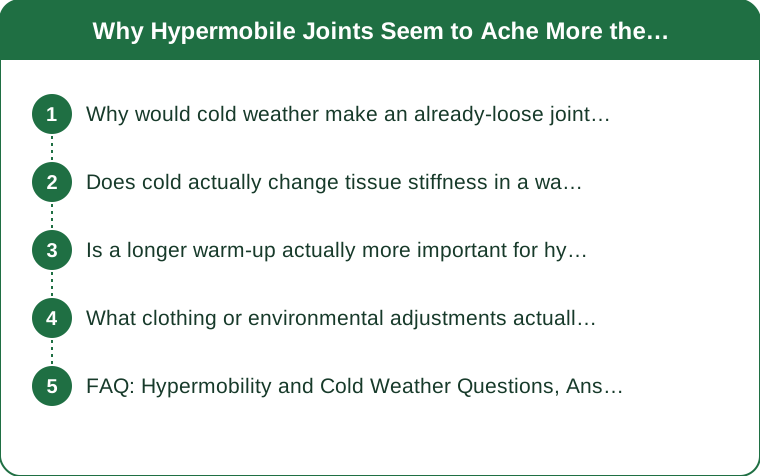
Why would cold weather make an already-loose joint feel even less stable?
Cold reduces blood flow to peripheral tissues, including the ligaments and joint capsules that hypermobile joints already rely on more heavily for stability (since the surrounding muscles have to compensate for laxity that isn’t well-controlled by connective tissue alone). With reduced circulation, that already-compensating muscular support tends to respond slightly slower, which reads as increased looseness or instability specifically in cold conditions.
Does cold actually change tissue stiffness in a way that matters here?
Yes — connective tissue, including tendons and ligaments, measurably stiffens at lower temperatures, which sounds like it should mean less looseness, but in practice it usually shows up as reduced smooth range of motion and more friction-related discomfort during movement, rather than genuine joint tightening. For hypermobile joints already moving beyond a typical range, that added stiffness at the edges of motion often registers as ache rather than relief.

Is a longer warm-up actually more important for hypermobile joints in cold conditions?
Considerably more important than for an average joint — since hypermobile joints depend more on active muscular stabilization than passive ligament support, and cold slows the muscular response time, a warm-up that gradually raises tissue temperature and activates stabilizing muscles before real load or range of motion is asked of the joint meaningfully reduces the discomfort and instability risk specific to cold-weather sessions.
What clothing or environmental adjustments actually help beyond just warming up longer?
Keeping the specific joints that tend to bother you covered and warm between sets or activity bouts (compression sleeves, knee or elbow warmers) helps maintain the tissue temperature gained during warm-up rather than letting it drop again during rest periods, which is a common and easily overlooked gap in cold-weather training for hypermobile joints.
FAQ: Hypermobility and Cold Weather Questions, Answered
Does this mean hypermobile joints are more prone to actual injury in cold weather, not just discomfort?
There’s reasonable evidence that inadequate warm-up in cold conditions increases injury risk generally, and this risk is plausibly elevated for hypermobile joints specifically given their greater reliance on active muscular stabilization — extending warm-up time is a sensible precaution either way.
Should hypermobile individuals avoid outdoor training entirely once temperatures drop?
Not necessarily — with a longer, more thorough warm-up and appropriate joint coverage, outdoor training in cool conditions is generally still reasonable; extreme cold or very short warm-up windows are where the added caution matters most.
Does this cold-weather effect ease once the body fully warms up during a session?
Yes, typically — most people notice the excess stiffness and instability feeling ease substantially once tissue temperature rises during the first 10-15 minutes of consistent movement, which is exactly why that initial warm-up window matters so much.
TL;DR:
- Cold weather reduces blood flow and increases connective tissue stiffness, both of which hit hypermobile joints harder
- The muscular stabilization hypermobile joints depend on responds more slowly when tissue is cold
- A longer, more gradual warm-up matters more for hypermobile joints in cold conditions than for average joints
- Keeping key joints covered between activity bouts helps maintain warm-up gains through a session
The cold-weather ache is a real physiological shift, not your hypermobility getting worse — and it responds well to a longer warm-up and staying covered between sets.
Keep Reading
This article is for general informational purposes only and is not medical advice. Always consult a qualified health professional for guidance specific to you.