Why Hypermobile People Lose Balance the Moment They Close Their Eyes
Quick Answer: Balance runs on three inputs - vision, the inner ear, and proprioception, your sense of where your joints are. Hypermobile joints send weaker and noisier proprioceptive signals, because the receptors that report joint position sit in ligaments and capsules that are more lax than average. So you compensate with vision, heavily and unconsciously. Close your eyes and you remove the input you have been leaning on, and the shortfall becomes obvious immediately.
The good news is that this is one of the most trainable things in hypermobility, and eyes-closed work is exactly how you train it.
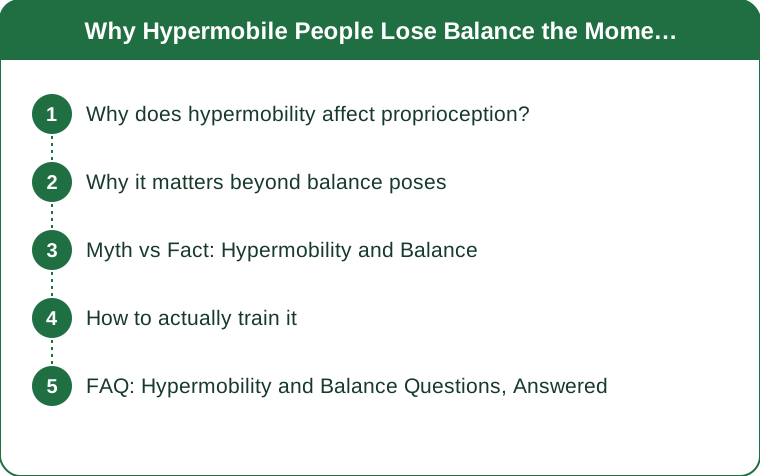
Why does hypermobility affect proprioception?
The receptors that tell your brain where a joint is are embedded in the tissue around the joint, and that tissue behaves differently in hypermobile bodies.
Where the signal comes from. Position sense is assembled from mechanoreceptors in ligaments, joint capsules, muscle spindles, and tendons. Ligaments and capsules stretch further before they generate a signal in a hypermobile joint, which means the warning that you are approaching the end of range arrives later and quieter.
What that produces in practice:
- A wider zone in which you genuinely do not know where the joint is. Research consistently finds reduced joint position sense accuracy in hypermobile people, and the effect is largest at the knee and ankle
- A later end-range signal, which is why hypermobile people can move into positions that surprise them
- More reliance on vision to fill the gap, established so early and so automatically that most people have no idea they are doing it
The compensation is invisible until you remove it. You are not consciously watching your foot. Your brain is using peripheral visual information about the room to calculate where your body is, continuously, and it has been doing so for years. Shut your eyes and that calculation stops.
This is also why the difference is dramatic rather than subtle. It is not that balance gets a bit harder - a whole input channel goes offline, and it was carrying more of the load than it does for most people.
Why it matters beyond balance poses
If this only affected yoga, it would be a curiosity. It affects considerably more than that.
Ankle sprains. Reduced proprioception is one of the strongest predictors of ankle sprain and re-sprain, because the corrective muscle response fires late. This is a large part of why hypermobile people roll ankles more often on uneven ground.
Low light and darkness. Walking to the bathroom at night, an unlit path, a dim studio - anywhere vision is degraded, your balance degrades disproportionately. Many hypermobile people report feeling unsteady in the dark and assume it is something else.
Fatigue. Late in a workout or late in the day, muscle-based compensation weakens and the shortfall shows up. This is why form deteriorates faster in hypermobile people than the level of muscular fatigue would explain.
Water and unstable surfaces. Standing in a pool, on sand, on a boat - the surface stops giving reliable feedback and the visual reference moves. Some people find this exhausting rather than merely difficult.
And crowded or visually busy environments. When the visual field is chaotic - a busy shop, a crowd, a moving train - the visual reference you depend on becomes unreliable, and the resulting unsteadiness or fatigue is a genuine and commonly reported experience rather than anxiety.
Myth vs Fact: Hypermobility and Balance
Myth: Poor balance with your eyes closed means something is wrong with your inner ear. Fact: It can, and that is worth checking if it is new or severe. But in hypermobility the far more likely explanation is proprioceptive, and the pattern is distinctive - fine with eyes open, poor with eyes closed, and better on a firm surface than a soft one.
Myth: More stretching will help. Fact: Stretching is generally the wrong direction here - increasing range does nothing for position sense and can add to the instability. Strength and controlled loading are what improve proprioceptive accuracy.
Myth: You either have good proprioception or you do not. Fact: Proprioceptive training produces measurable improvements, and balance work is among the better-supported interventions for hypermobility. This is one of the genuinely fixable pieces.
Myth: If you can hold a balance with eyes open, your balance is fine. Fact: It means your visual compensation is working. The eyes-open test flatters you and hides the actual deficit, which is why it is the wrong test to train against.
How to actually train it
The principle is simple: remove or degrade vision, add stability elsewhere, and progress slowly.
The progression, in order:
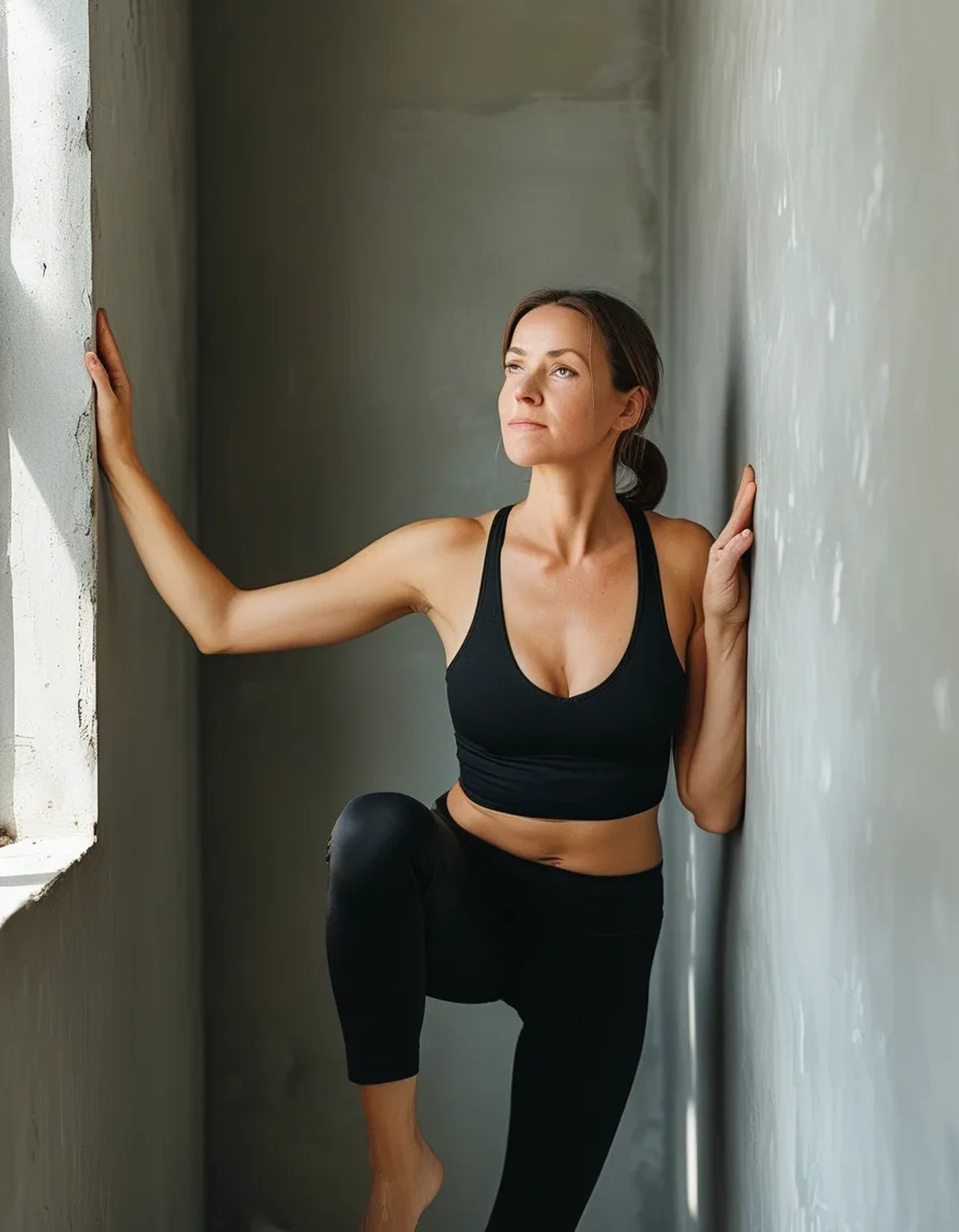
- Two feet, eyes closed, near a wall. Hold 30 seconds. Boring, and where most people should start
- Two feet, eyes closed, on a folded towel - a slightly compliant surface degrades the surface feedback too
- Single leg, eyes open, 30 seconds each side
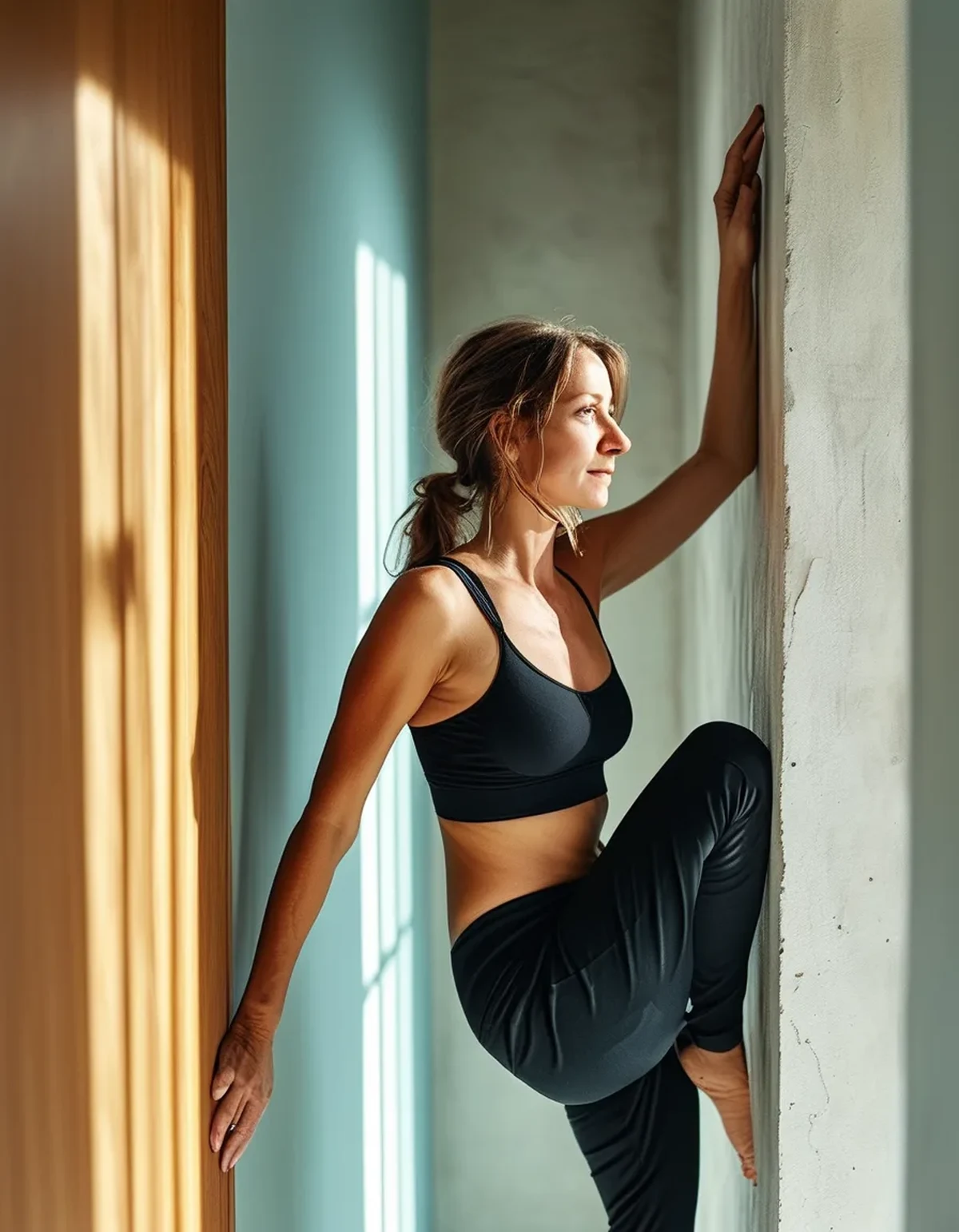
- Single leg, eyes closed, fingertips on a wall. Expect this to be dramatically harder than the eyes-open version - a drop from 30 seconds to 5 is completely normal at the start
- Single leg, eyes closed, no contact. This is the goal, and it takes weeks rather than days
- Head turns while balancing, which challenges the vestibular contribution as well
The rules that make it work:
- Always within reach of a wall or a chair. Not because you are fragile - because falling teaches nothing
- Little and often. Two or three minutes daily beats twenty minutes weekly for this specific adaptation
- Do not lock the knee. Hypermobile knees will hyperextend into the balance and that is the position you are trying to train out of. Keep a soft bend, which is genuinely harder and is the actual work
- Strengthen alongside it. Calf raises, single-leg work, and ankle strength all contribute, since muscle is the compensation channel you can actually improve
Expect four to six weeks before it feels different, and expect the improvement to show up first as fewer stumbles on uneven ground rather than as a better balance time. If your balance has recently and noticeably worsened rather than being lifelong, that is a reason to see a professional rather than to train harder. This is general information, not medical advice.
FAQ: Hypermobility and Balance Questions, Answered
Is a wobble board or balance cushion useful?
Useful later, unhelpful early. An unstable surface removes reliable feedback at exactly the moment you are trying to build accuracy from it. Get comfortable on a firm floor with eyes closed first, then add instability - most people do this in the opposite order and progress slowly as a result.
Why is my left side so much worse than my right?
Asymmetry is extremely common, and it is usually a history of injury on that side plus a lifetime of unconsciously loading the other one. Train the weaker side twice as often for a few weeks rather than doing equal sets - equal work maintains the gap.
Does this get worse with age?
Proprioception declines with age in everyone, so a lower starting point matters more later. That is an argument for training it now rather than a reason for pessimism - the trainability does not disappear.
Should I be doing this if I get dizzy?
Dizziness is a different signal and deserves its own explanation before you train around it. Balance work with eyes closed can provoke dizziness in people with a vestibular issue, and it should be assessed rather than pushed through.
TL;DR:
- Hypermobile joints send weaker position signals, so vision quietly carries more of your balance than it does for most people
- Closing your eyes removes that compensation and exposes the actual deficit
- It shows up in ankle sprains, darkness, fatigue, and visually busy environments - not just in balance poses
- Train it with eyes-closed holds near a wall, soft knee, two or three minutes daily
- Stretching does not help; strength and controlled balance work do, over four to six weeks
Start with 30 seconds on two feet with your eyes shut, standing next to a wall. If that is harder than you expected, you have found the thing worth training.
Keep Reading
This article is for general informational purposes only and is not medical advice. Always consult a qualified health professional for guidance specific to you.