Why Overhead Movements Feel Unstable When You Are Hypermobile
Quick Answer: Overhead work feels unstable with hypermobility because the shoulder is the least bony-constrained joint in the body — it depends almost entirely on soft tissue for stability, and lax soft tissue means the joint reaches end range without the usual mechanical stop. The fix is building active stability: slower tempos, isometric holds, lighter loads held for longer, and stopping short of your full available range rather than chasing it.
The weight is light. The movement is simple. And at the top your shoulder feels like it is hovering somewhere it should not be.
That sensation is not anxiety. It is proprioceptive information about a joint that has gone beyond where it is stable.

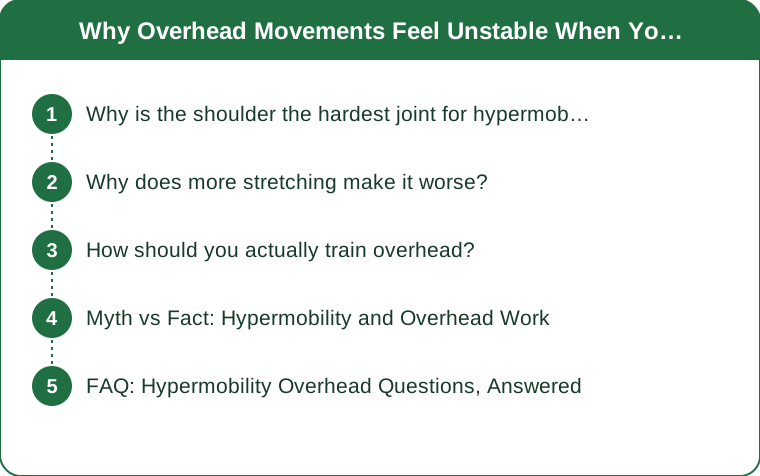
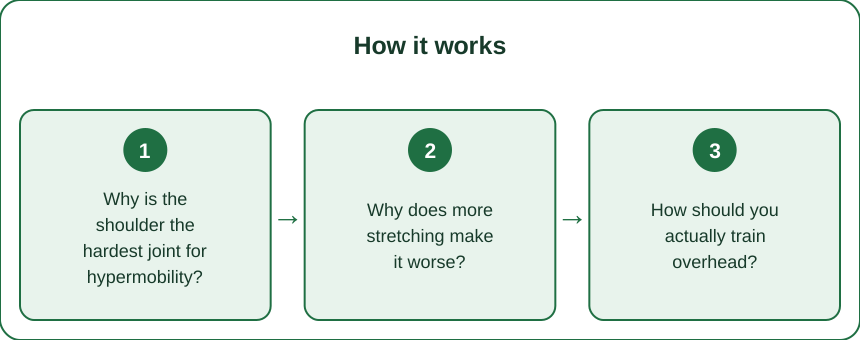
Why is the shoulder the hardest joint for hypermobility?
Because it trades stability for range by design, and hypermobility pushes that trade further.
The shoulder socket is shallow. The head of the humerus sits against a small, shallow glenoid — commonly compared to a golf ball on a tee. That geometry is what allows the enormous range of motion the shoulder has, and it means bone provides very little of the stability.
Almost all the stability is soft tissue. Ligaments, the joint capsule, the labrum and the surrounding musculature do the work. When connective tissue is more extensible, as it is in hypermobility, the passive restraints give way sooner and the joint relies more heavily on muscle to control position.
End range arrives without a stop. In a typically mobile shoulder, the ligaments tighten and provide a clear mechanical endpoint. Hypermobile shoulders often reach further before that endpoint, and the sensation at the top is of the joint continuing to travel with nothing catching it.
Proprioception is frequently reduced. People with generalised hypermobility often have less accurate joint position sense, which means your brain has poorer information about exactly where the joint is. Overhead is the position with the least visual feedback available, which makes it the worst case.
Fatigue removes what stability you have. Because muscle is doing a larger share of the stabilising job, muscular fatigue causes a disproportionate loss of joint control. This is why the fifth set feels far less stable than the first, and why long sessions produce the worst symptoms.
Why does more stretching make it worse?
Because the limitation is not tightness, even when it feels like tightness.
Hypermobile joints frequently feel tight. Muscles around an unstable joint work continuously to provide the stability the ligaments are not providing, and that constant low-level contraction produces a genuine sensation of tightness. The instinct is to stretch it.
Stretching removes the protection. Reducing the tone of muscles that are actively compensating leaves the joint with less control, which typically produces temporary relief followed by a worse feeling within hours.
Chasing more range moves the problem outward. Additional range in a joint that already lacks control means more territory to stabilise, and the newly gained end range is the least controlled part of it.
The useful direction is strength through range, not more range. Loaded, controlled work in the middle of your available range builds the active stability that the passive structures are not supplying.
Warm-up should be movement, not stretching. Hypermobile joints generally need a longer warm-up than average to feel controlled, but the content should be light, progressive loading — band work, light presses, controlled reaches — rather than static holds.

How should you actually train overhead?
With a specific set of adjustments that make overhead work not just possible but genuinely valuable.
Do not press to full lockout at first. Stopping slightly short of your absolute end range keeps you in the part of the range you can control. This is not permanent — it is the starting point.
Use isometric holds heavily. Holding a light weight overhead for 20 to 30 seconds builds the endurance of the stabilising muscles far more effectively than repetitions do, and isometrics are consistently reported as more comfortable by people with hypermobility.
Slow every tempo down. Three seconds up, three seconds down. Fast movement relies on momentum, which is exactly what an under-controlled joint cannot manage.
Choose positions that provide external support early. Half-kneeling, seated with a back support, or supported single-arm work all reduce the amount of stabilising your shoulder has to do alone, and let you load the movement sooner.
Build the scapula first. Overhead stability starts at the shoulder blade. Serratus anterior and lower trapezius work — wall slides, prone Y and T raises, scapular push-ups — gives the humerus a stable base to move on.
Load heavier than feels intuitive, in controlled ranges. A common mistake is training exclusively with very light weight forever. Progressive loading in a safe range is what actually builds the stability, and staying at two kilograms indefinitely will not get there.
Expect it to take longer than average. Building the active stability that replaces passive restraint takes months of consistent work, not weeks. The progress is real and it is slower.
Cooler weather makes it worse before it makes it better. Many hypermobile people report joints feeling less controlled and warm-ups taking longer as temperatures drop. Extending your warm-up by five minutes through autumn is a sensible pre-emptive adjustment rather than something to work out in October.
If you have recurrent shoulder subluxations or dislocations, or pain that persists, work with a physiotherapist experienced in hypermobility rather than following general guidance. This is general information, not medical advice.
Myth vs Fact: Hypermobility and Overhead Work
Myth: You should avoid overhead work entirely. Fact: Avoidance leaves the joint weak in the exact position where it needs the most control. Modified overhead work is usually far better than none.
Myth: The tightness means you need to stretch. Fact: Muscular tightness around a hypermobile joint is usually protective. Stretching it away tends to increase instability.
Myth: Light weights forever is the safe approach. Fact: Progressive load is what builds stabilising capacity. The adjustment should be range, tempo and position — not permanent avoidance of load.
Myth: Clicking and popping means damage. Fact: Painless joint noise is extremely common in hypermobility and generally not concerning. Noise accompanied by pain, swelling or a sensation of the joint giving way is different.
Myth: If it feels unstable, stop the exercise. Fact: Reduce the range or the load rather than dropping the movement. The instability sensation is information about dose, not a verdict on the exercise.
FAQ: Hypermobility Overhead Questions, Answered
Why does my shoulder feel fine one day and unstable the next?
Sleep, fatigue, hydration, and where you are in a training week all affect muscular control, and muscle is doing most of the stabilising. Day-to-day variation is expected.
Are isometrics really better?
Many people with hypermobility find them more comfortable and more effective early on, because they build stabiliser endurance without requiring control through a moving range.
Should I use a shoulder brace or taping?
Taping can provide useful proprioceptive feedback for some people. Relying on rigid support long term is generally not recommended, because it substitutes for the control you are trying to build.
How long until overhead work feels normal?
Months rather than weeks. Consistency matters more than intensity, and progress usually shows first as reduced fatigue rather than as increased weight.
Can I do overhead sports like swimming or climbing?
Many people with hypermobility do both successfully, with adequate strength work alongside. Building stability first and volume second is the usual order.
Why do I feel worse the day after a long session?
Stabilising muscles fatigue and take time to recover, and until they do the joint has less active control. Shorter, more frequent sessions often work better than long ones.
TL;DR:
- The shoulder relies almost entirely on soft tissue for stability — lax tissue means end range arrives with no mechanical stop.
- The tightness you feel is usually protective muscle tone. Stretching it removes what stability you have.
- Train with isometric holds, slow tempos, supported positions, and stop short of full lockout at first.
- Build the scapula first — overhead stability starts at the shoulder blade.
- Progressive load is essential. Staying at very light weights forever will not build the control you need.
Extend your warm-up now, before cooler mornings make it a problem.
Keep Reading
This article is for general informational purposes only and is not medical advice. Always consult a qualified health professional for guidance specific to you.