Why Your Sleep Position Decides How Stiff You Wake Up With Hypermobility
Quick Answer: Morning stiffness with hypermobility usually comes from joints resting at end range all night rather than from your training. Muscles relax during sleep, so nothing holds a joint back from its outer limit. Support the joints that drift furthest - shoulders, hips, and neck - with pillows that fill the gaps, and the first twenty minutes of your day change noticeably within a week.
You did nothing unusual yesterday and you woke up feeling like you did.
The thing that changed was not your workout. It was the eight hours in between.

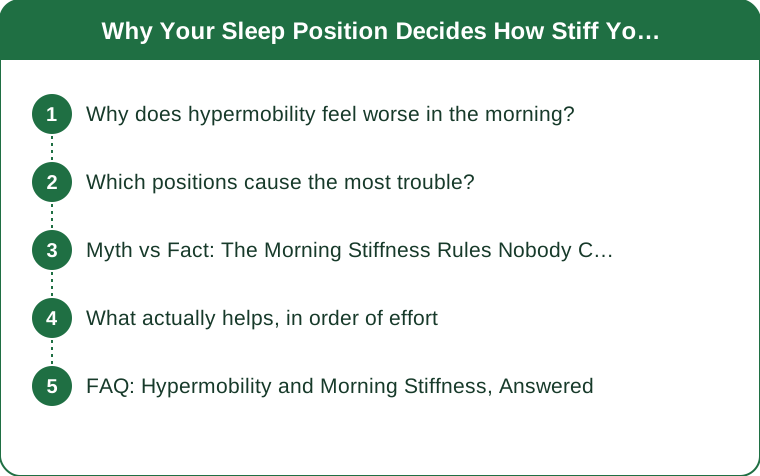
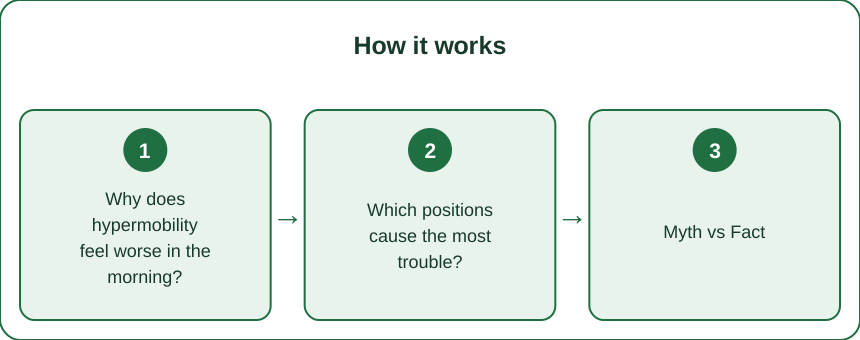
Why does hypermobility feel worse in the morning?
Muscle tone drops during sleep. During the day your muscles are constantly making small corrections that keep a joint away from its outer limit, and you never notice it happening.
At night that guarding switches off. A hypermobile shoulder or hip that has more available range than average will settle into that extra range and stay there for hours.
Held tissue gets stiff, and stiff is exactly what it feels like on waking. This is why the sensation is so often described as tight rather than loose - the tissue has been at length all night and it complains about it.
Circulation drops too, and joints with more laxity tend to have a bit more fluid movement in and out of the capsule. That combination is the classic gel-like feeling that takes fifteen or twenty minutes to shift.
The tell that it is positional and not training-related: the stiffness is asymmetric, and it is worst on whichever side you sleep on. Training soreness does not usually pick sides that cleanly.
It is also why the stiffness can be worst after a rest day, which confuses people into thinking they need to train more. You just spent an easy day and then eight hours at end range with nothing to blame it on.
Which positions cause the most trouble?
Side sleeping with the top arm draped forward is the biggest one. The shoulder rolls into internal rotation and the joint sits at the far end of it all night, which is why the first overhead reach of the day feels unstable.
Stomach sleeping turns the neck to end range and holds it there for hours, and the hypermobile neck goes further than average before anything stops it. Waking with a one-sided neck ache and no injury to explain it is almost always this.
Frog-leg positions - one knee pulled up high while on your front or side - park the hip at the outer edge of external rotation and abduction. The morning hip pinch that eases after walking is usually this position, not anything you did in the gym.
Sleeping with your arms overhead loads the shoulder capsule and can numb the hands, which people often misread as a nerve problem.
Hands curled tightly under a pillow hold the small finger joints in flexion, and hypermobile hands stiffen there quickly - it is why the first mug of the day feels awkward to grip.
The pattern across all five: none of them are dangerous, and none of them need to be eliminated. They need to be supported so the joint stops at a normal range instead of yours.

Myth vs Fact: The Morning Stiffness Rules Nobody Checks
Myth: stiffness means you need to stretch first thing. Fact: stretching a joint that has been at end range all night adds more of exactly what caused the problem. Gentle movement through mid-range does more in two minutes than stretching does in ten.
Myth: a firmer mattress fixes it. Fact: mattress firmness matters far less than gap filling. A firm mattress with an unsupported waist gap can be worse than a soft one with a pillow in the right place.
Myth: morning stiffness means the previous day was too hard. Fact: with hypermobility it often means the previous day was too easy. Less muscle activity through the day means less residual tone at night.
Myth: you should sleep on your back because it is neutral. Fact: flat on your back with no knee support tips the pelvis and parks the low back at end range. Neutral requires props, whatever position you are in.
Myth: it will settle as you get used to a new bed. Fact: positional stiffness does not adapt away, because the joint keeps going to the same place every night. Change the position or it repeats.
Myth: warm showers are the fix. Fact: they help the sensation and do nothing about the cause, which is fine as long as you know which one you are treating.
What actually helps, in order of effort
Fill the gaps first, since it is free. A pillow hugged to the chest stops the top shoulder from rolling forward, a pillow between the knees stops the top hip from dropping into adduction, and a small towel roll at the waist keeps the side-lying spine level.
Get the pillow height right. With hypermobility the neck will go wherever the gap allows, so the pillow needs to fill the exact distance between shoulder and head - not less, not a stack of three.
Do ninety seconds of mid-range movement before you get out of bed. Ten slow knee rocks side to side, ten shoulder rolls, ten ankle circles. The goal is circulation and gentle joint loading, not range.
Then load something within the first hour. A set of ten sit-to-stands from a chair or a thirty-second wall sit gives the system the muscular input it lacked all night, and it consistently shortens the stiff window.
Build isometric strength in the joints that stiffen most, three days a week. Holds of 20 to 30 seconds, 3 sets, at moderate effort - this is the only part of the list that changes the baseline rather than managing the morning.
Give any change ten nights before judging it, and change one variable at a time. If you swap pillow, mattress topper, and position at once you will not know which one mattered, and with hypermobility the answer is usually one specific gap.
FAQ: Hypermobility and Morning Stiffness, Answered
How long should morning stiffness last?
Fifteen to twenty minutes of easing with gentle movement is common with hypermobility. Stiffness that lasts over an hour, or comes with swelling, warmth, or symmetrical joint pain, is worth a professional opinion rather than a pillow change.
Is it better to sleep on my back or my side?
Whichever you can support properly. Side sleeping with a pillow at the chest and between the knees is often easiest to set up; back sleeping needs a pillow under the knees to stop the low back sitting at end range.
Should I stretch when I wake up stiff?
Move rather than stretch. Mid-range movement - knee rocks, shoulder rolls, ankle circles - restores circulation without adding more end range to joints that have had eight hours of it.
Why is one side always worse?
Because you sleep on it. Asymmetric morning stiffness that matches your sleep side is the clearest sign the cause is positional rather than training-related.
Do compression garments help overnight?
Some people find light compression on a problem joint reduces the drift into end range and improves the morning. It is worth a two-week trial, and it should never be tight enough to mark the skin.
Does this get worse in cooler weather?
Often, yes. Cooler rooms mean less peripheral circulation and more time spent curled tightly, which is more end range. As nights cool over the next few weeks, expect the morning window to lengthen slightly.
When should I see someone about it?
If stiffness comes with numbness that does not resolve, a joint that gives way, night pain that wakes you, or steady worsening over weeks. This is general information, not medical advice.
TL;DR:
- Morning stiffness with hypermobility usually comes from joints resting at end range all night, not from your training.
- Muscle guarding switches off during sleep, so nothing stops a lax joint reaching its outer limit and staying there.
- Asymmetric stiffness that matches your sleep side is the giveaway that the cause is positional.
- Fill the gaps - pillow at the chest, between the knees, correct pillow height - before changing mattresses.
- Move through mid-range for ninety seconds before getting up, then load something in the first hour.
Change one thing at a time and give it ten nights. The fix is usually one specific gap, not the whole setup.
Keep Reading
This article is for general informational purposes only and is not medical advice. Always consult a qualified health professional for guidance specific to you.